
Willie Nelson - Rhe Troubadour, West Hollywood, Ca. November 6th, 1975 (Remastered, Live On Broadcasting) '2025
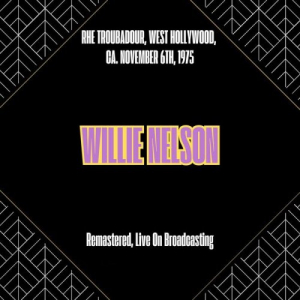
| Artist | Willie Nelson Related artists |
| Album name | Rhe Troubadour, West Hollywood, Ca. November 6th, 1975 (Remastered, Live On Broadcasting) |
| Country | |
| Date | 2025 |
| Genre | Country |
| Play time | 1:02:22 |
| Format / Bitrate | Stereo 1420 Kbps
/ 44.1 kHz MP3 320 Kbps |
| Media | CD |
| Size | 375 MB |
| Price | Download $3.95 |
Order this album and it will be available for purchase and further download within 12 hours
Pre-order album Tracks list
	Tracklist:

1. Introduction (Live) (00:12)
2. Whiskey River (Live) (04:34)
3. Stay All Night (Live) (02:55)
4. Funny How Time Slips Away (Live) (02:28)
5. Crazy (Live) (01:36)
6. Nightlife (Live) (03:54)
7. Me & Paul (Live) (02:44)
8. Bloody Mary Morning (Live) (02:35)
9. I Still Can't Believe You're Gone (Live) (04:08)
10. It's Not Supposed to Be That Way (Live) (02:04)
11. Good Hearted Woman (Live) (02:52)
12. Station Promo (Live) (00:11)
13. Time of the Preacher (Live) (02:09)
14. I Could Not Believe It Was True (Live) (01:08)
15. Time of the Preacher Theme (Live) (01:15)
16. Blue Rock Montana (Live) (01:29)
17. Blue Eyes Crying in the Rain (Live) (02:18)
18. Red Headed Stranger (Live) (03:15)
19. Time of the Preacher Theme (Live) (02:00)
20. Instrumental (Live) (01:27)
21. Band Introductions (Live) (01:00)
22. What Can You Do to Me Now? (Live) (03:23)
23. Shotgun Willie (Live) (02:40)
24. A Song for You (Live) (02:59)
25. Rollin' in My Sweet Baby's Arms (Live) (03:01)
26. Will the Circle Be Unbroken? (Live) (03:54)


 moreNelson began performing music as a child growing up in Abbott, Texas.
After his father died and his mother ran away, Nelson and his sister Bobbie were
raised by their grandparents, who encouraged both children to play instruments.
Willie picked up the guitar, and by the time he was seven, he was already
writing songs. Bobbie learned to play piano, eventually meeting -- and later
marrying -- fiddler Bud Fletcher, who invited both of the siblings to join his
band. Nelson had already played with Raychecks' Polka Band, but with Fletcher,
he acted as the group's frontman. Willie stayed with Fletcher throughout high
school. Upon his graduation, he joined the Air Force but had to leave shortly
afterward when he became plagued by back problems. Following his disenrollment
from the service, he began looking for full-time work.

After working several part-time jobs, he landed one as a country DJ at Fort
Worth's KCNC in 1954. Nelson continued to sing in honky tonks as he worked as a
DJ, deciding to make a stab at recording career by 1956. That year, he headed to
Vancouver, Washington, where he recorded Leon Payne's "Lumberjack." At that
time, Payne was a DJ and he plugged "Lumberjack" on the air, which eventually
resulted in sales of 3,000 -- a respectable figure for an independent single,
but not enough to gain much attention. For the next few years, Nelson continued
to DJ and sing in clubs. During this time, he sold "Family Bible" to a guitar
instructor for 50 dollars, and when the song became a hit for Claude Gray in
1960, Nelson decided to move to Nashville the following year to try his luck.
Though his nasal voice and jazzy, off-center phrasing didn't win him many
friends -- several demos were made and then rejected by various labels -- his
songwriting ability didn't go unnoticed, and soon Hank Cochran helped Willie
land a publishing contract at Pamper Music. Ray Price, who co-owned Pamper,
recorded Nelson's "Night Life" and invited him to join his touring band, the
Cherokee Cowboys, as a bassist.

Arriving at the beginning of 1961, Price's invitation began a watershed year for
Nelson. Not only did he play with Price -- eventually taking members of the
Cherokee Cowboys to form his own touring band -- but his songs also provided
major hits for several other artists. Faron Young took "Hello Walls" to number
one for nine weeks, Billy Walker made "Funny How Time Slips Away" into a Top 40
country smash, and Patsy Cline made "Crazy" into a Top Ten pop crossover hit.
Earlier in the year, he signed a contract with Liberty Records and began
releasing a series of singles that were usually drenched in strings.
"Willingly," a duet with his then-wife Shirley Collie, became a Top Ten hit for
Nelson early in 1962, and it was followed by another Top Ten single, "Touch Me,"
later that year. Both singles made it seem like Nelson was primed to become a
star, but his career stalled just as quickly as it had taken off, and he was
soon charting in the lower regions of the Top 40. Liberty closed its country
division in 1964, the same year Roy Orbison had a hit with "Pretty Paper."

When the Monument recordings failed to become hits, Nelson moved to RCA Records
in 1965, the same year he became a member of the Grand Ole Opry. Over the next
seven years, he had a steady stream of minor hits, highlighted by the number 13
hit "Bring Me Sunshine" in 1969. Toward the end of his stint with RCA, he had
grown frustrated with the label, which had continually tried to shoehorn him
into the heavily produced Nashville sound. By 1972, he wasn't even able to reach
the country Top 40. Discouraged by his lack of success, Nelson decided to retire
from country music, moving back to Austin, Texas, after a brief and disastrous
sojourn into pig farming. Once he arrived in Austin, Nelson realized that many
young rock fans were listening to country music along with the traditional honky
tonk audience. Spotting an opportunity, Nelson began performing again, scrapping
his pop-oriented Nashville sound and image for a rock- and folk-influenced
redneck outlaw image. Soon, he earned a contract with Atlantic.

Shotgun Willie (1973), Nelson's first album for Atlantic, was evidence of the
shift of his musical style, and although it initially didn't sell well, it
earned good reviews and cultivated a dedicated cult following. By the fall of
1973, his version of Bob Wills' "Stay All Night (Stay a Little Longer)" had
cracked the country Top 40. The following year, he delivered the concept album
Phases and Stages, which increased his following even more with the hit singles
"Bloody Mary Morning" and "After the Fire Is Gone." But the real commercial
breakthrough didn't arrive until 1975, when he severed ties with Atlantic and
signed to Columbia Records, which gave him complete creative control of his
records. Nelson's first effort for Columbia, The Red Headed Stranger, was a
spare concept album about a preacher, featuring only his guitar and his sister's
piano. The label was reluctant to release it with such stark arrangements, but
they relented and it became a huge hit, thanks to Nelson's understated cover of
Roy Acuff's "Blue Eyes Crying in the Rain."

Following the breakthrough success of The Red Headed Stranger, as well as Waylon
Jennings' simultaneous success, outlaw country -- so named because it worked
outside of the confines of the Nashville industry -- became a sensation, and RCA
compiled the various-artists album Wanted: The Outlaws!, using material Nelson,
Jennings, Tompall Glaser, and Jessi Colter had previously recorded for the
label. The compilation boasted a number one single in the form of the newly
recorded Jennings and Nelson duet "Good Hearted Woman," which was also named the
Country Music Association's single of the year. For the next five years, Nelson
consistently charted on both the country and pop charts, with "Remember Me," "If
You've Got the Money I've Got the Time," and "Uncloudy Day" becoming Top Ten
country singles in 1976; "I Love You a Thousand Ways" and the Mary Kay Place
duet "Something to Brag About" were Top Ten country singles the following year.

Nelson enjoyed his most successful year to date in 1978, as he charted with two
very dissimilar albums. Waylon and Willie, his first duet album with Jennings,
was a major success early in the year, spawning the signature song "Mammas Don't
Let Your Babies Grow Up to Be Cowboys." Later in the year, he released Stardust,
a string-augmented collection of pop standards produced by Booker T. Jones. Most
observers believed that the unconventional album would derail Nelson's career,
but it unexpectedly became one of the most successful records in his catalog,
spending almost ten years in the country charts and eventually selling over four
million copies. After the success of Stardust, Willie branched out into film,
appearing in the Robert Redford movie The Electric Horseman in 1979 and starring
in Honeysuckle Rose the following year. The latter spawned the hit "On the Road
Again," which became another one of Nelson's signature songs.

Nelson continued to have hits throughout the early '80s, when he had a major
crossover success in 1982 with a cover of Elvis Presley's hit "Always on My
Mind." The single spent two weeks at number one and crossed over to number five
on the pop charts, sending the album of the same name to number two on the pop
charts as well as quadruple-platinum status. Over the next two years, he had hit
duet albums with Merle Haggard (1983's Poncho & Lefty) and Jennings (1982's WWII
and 1983's Take It to the Limit), while "To All the Girls I've Loved Before," a
duet with Latin pop star Julio Iglesias, became another major crossover success
in 1984, peaking at number five on the pop charts and number one on the country
singles chart.

Following a string of number one singles in early 1985, including "Highwayman,"
the first single from the Highwaymen, a supergroup he formed with Jennings,
Johnny Cash, and Kris Kristofferson, Nelson's popularity gradually began to
erode. A new generation of artists had captured the attention of the country
audience, which began to drastically cut into his own audience. For the
remainder of the decade, he recorded less frequently and remained on the road;
he also continued to do charity work, most notably Farm Aid, an annual concert
that he founded in 1985 designed to provide aid to ailing farmers. While his
career was declining, an old demon began to creep up on him: the IRS. In
November 1990, Nelson was given a bill for $16.7 million in back taxes. During
the following year, almost all of his assets -- including several houses,
studios, farms, and various properties -- were taken away, and to help pay his
bill, he released the double album The IRS Tapes: Who'll Buy My Memories?
Originally released as two separate albums, the records were marketed through
television commercials, and all the profits were directed to the IRS. By 1993 --
the year he turned 60 -- his debts had been paid off, and he relaunched his
recording career with Across the Borderline, an ambitious album produced by Don
Was and featuring cameos by Bob Dylan, Bonnie Raitt, Paul Simon, Sinéad
O'Connor, David Crosby, and Kris Kristofferson. The record received strong
reviews and became his first solo album to appear in the pop charts since 1985.

After the release of Across the Borderline, Nelson continued to work steadily,
releasing at least one album a year and touring constantly. In 1993, he was
inducted into the Country Music Hall of Fame, but by that time, he had already
become a living legend for all country music fans across the world. Signing to
Island for 1996's Spirit, he resurfaced two years later with the critically
acclaimed Teatro, produced by Daniel Lanois. Nelson followed up that success
with the instrumental-oriented Night and Day a year later; Me and the Drummer
and Milk Cow Blues followed in 2000. The Rainbow Connection, which featured an
eclectic selection of old-time country favorites, appeared in spring 2001.

Amazingly prolific as a recording artist, Nelson released The Great Divide on
Universal in 2002. A collection of his early-'60s publishing demos for Pamper
Music called Crazy: The Demo Sessions came out on Sugar Hill in 2003. Later that
year, Nelson released Run That by Me One More Time, which reunited him with Ray
Price and kicked off a relationship with Lost Highway Records. It Always Will Be
and Outlaws and Angels both appeared on Lost Highway in 2004, followed by the
release of Nelson's long-delayed attempt at a country-reggae fusion, Countryman,
also on Lost Highway, in 2005. You Don't Know Me: The Songs of Cindy Walker
arrived the following year, along with Songbird, Nelson's collaboration with
alt-country singer/songwriter Ryan Adams and his band the Cardinals. The
double-disc Last of the Breed, an ambitious project that paired Nelson with
Merle Haggard, Ray Price, and Asleep at the Wheel, was released by Lost Highway
in 2007, followed by the Kenny Chesney/Buddy Cannon-produced Moment of Forever a
year later in 2008.

Also in 2008, Nelson paired with jazz trumpeter Wynton Marsalis for the live
album Two Men with the Blues, and with harmonica player and producer Mickey
Raphael for some serious-repair remixes of vintage Nelson releases from RCA
originally recorded between 1966 and 1970 called Naked Willie. Lost Highway, an
album of duets with country and pop singers ranging from Shania Twain to Elvis
Costello, appeared in 2009. Also appearing in 2009 was the jazz-inflected
American Classic from Blue Note. Country Music followed next from Rounder in
2010. Nelson reunited with Marsalis again for 2011's Here We Go Again:
Celebrating the Genius of Ray Charles, which was recorded live on February 9 and
10, 2009, at the Rose Theater with Norah Jones also on board. A CD drawn from
the shows appeared on Blue Note in the spring of 2011 and in the fall, Willie
released a covers collection called Remember Me, Vol. 1. He then signed with
Sony Legacy and released Heroes in the summer of 2012, following it in the
spring of the next year with a collection of standards called Let's Face the
Music and Dance. That fall, he released To All the Girls..., a collection of new
duets with female singers.

Nelson kept to a rigorous touring schedule despite the fact that he turned 80 in
2013. Though he'd been recording mostly covers for well over a decade, Nelson
re-engaged as a songwriter while traveling. Band of Brothers, issued in June
2014, featured nine originals (co-written with producer Buddy Cannon) among its
14 new songs. Six months later, Nelson launched a projected series of albums
(given the collective name Willie's Stash, devoted to music especially close to
his heart) with December Day, a low-key collaboration with his sister Bobbie
Nelson, in which they performed a set of old standards and lesser-known tunes
from Nelson's songbook. In 2015, Nelson teamed up with his old friend Merle
Haggard for Django and Jimmie, their first collaboration in 20 years. Preceded
by the single "It's All Going to Pot," the album debuted at number one on the
Billboard country chart upon its June 2015 release. Early in 2016, Nelson issued
Summertime: Willie Nelson Sings Gershwin, and later that year he saluted his
early inspiration, Ray Price, with For the Good Times: A Tribute to Ray Price.

Nelson returned to original songs in April 2017 with the album God's Problem
Child, which was once again co-produced by Buddy Cannon. Later that October,
Nelson released the second volume in the Willie's Stash series: Willie Nelson
and the Boys, a collection of classic country covers recorded with his sons
Lukas and Micah. That same month, Light in the Attic issued two catalog projects
by Nelson. Teatro: The Complete Sessions, produced by Daniel Lanois, included
seven previously unreleased tracks and a DVD of director Wim Wenders'
documentary of the live sessions for the album, which took place in a
picturesque vintage movie theater. The latter volume was a Record Store Day
reissue of the more somber 1996 Island Records' release of Spirit on gold vinyl.
Undercelebrated at the time of its release, it has become among the most
treasured outings of his late career, featuring the legendary fiddler Johnny
Gimble among its personnel.

In April 2018, Nelson and Cannon were back with another studio album, Last Man
Standing, which included the single "Me and You." The set debuted at number
three on the Billboard Top Country Albums chart. Five months later, Nelson
released My Way, a tribute to Frank Sinatra; it took home the Grammy for Best
Traditional Pop Vocal Album in 2019. He issued his next studio LP, Ride Me Back
Home, in June 2019. Its tracks were a mix of new material, co-written by Nelson
and Cannon, and covers of songs from Mac Davis, Billy Joel, and others. The
title track was co-written by Sonny Throckmorton and was the first single issued
from the album; it went on to win the Grammy for Best Country Solo Performance.
Nelson followed Ride Me Back Home with the mellow and elegiac First Rose of
Spring, which relied primarily on covers, including versions of Toby Keith's
"Don't Let the Old Man In" and Johnny Paycheck's "I'm the Only Hell My Mama Ever
Raised." The record debuted at number five on Billboard's Country Albums chart
and number 49 on its Top 200.

Nelson released the Grammy-nominated That's Life, his second album of Frank
Sinatra covers, in February 2021. Later that year, he issued The Willie Nelson
Family, a collection of spiritual tunes recorded with such family members as his
sister Bobbie, his daughters Amy and Paula, and his sons Lukas and Micah, who
both play in Promise of the Real.

Nelson's sister Bobbie died on March 10, 2022, roughly a month and a half before
Willie released A Beautiful Time, another collaboration with Buddy Cannon. The
album found Nelson addressing his mortality on such original tunes as "I Don't
Go to Funerals" and "Live Every Day," and it also featured covers of the
Beatles' "With a Little Help from My Friends" and Leonard Cohen's "Tower of
Song." A Beautiful Time won the Grammy Award for Best Country Album in 2023, the
same year Nelson won a trophy for Best Country Solo Performance for "Live
Forever," a cut from the Billy Joe Shaver tribute album of the same name. Nelson
saluted the great country songwriter Harlan Howard with I Don't Know a Thing
About Love: The Songs of Harlan Howard, which appeared in March 2023.

Five months later, Nelson delivered Bluegrass, in which he played several
selections from his songbook in a bluegrass style aided by such musicians as Dan
Tyminski, Rob Ickes, and Aubrey Haynie. It was the first album where Nelson
didn't play his signature guitar Trigger since he acquired the instrument in
1969. At the end of the year, he released Long Story Short: Willie Nelson 90, a
CD/Blu-ray documenting his celebratory birthday concerts at the Hollywood Bowl
in April 2023. He settled back into dusty Texas country with The Border, a 2024
album produced by Buddy Cannon that featured four Nelson originals and a pair of
songs co-written by Rodney Crowell. Also in 2024, he collaborated with his son
Micah on Last Leaf on the Tree, an album of primarily covers, including
renditions of songs by the Flaming Lips, Tom Waits, Beck, and others. ©
Stephen Thomas Erlewine


Willie Nelson - Rhe Troubadour, West Hollywood, Ca. November 6th, 1975.rar -
375.8 MB
Related artists
Willie Nelson
Album
- 2025 Flowin From My Mind (Live Austin 74)
- 2025 Oh What A Beautiful World
- 2025 Workin Man: Willie Sings Merle
- 2025 Across The Mornin Sky (Live)
- 2025 1984-12-31 The Summit Houston, TX (Remastered, Live On Broadcasting)
- 2025 Capitol Theater, Passaic, Nj. April 1st, 1979 (Remastered, Live On Broadcasting)
- 2025 Rhe Troubadour, West Hollywood, Ca. November 6th, 1975 (Remastered, Live On Broadcasting)
- 2024 The Border
- 2024 Last Leaf On The Tree
- 2024 At Midnight: Willie Nelson
- 2023 I Don't Know A Thing About Love: The Songs of Harlan Howard
- 2023 Bluegrass
- 2023 Greatest Hits
- 2023 Pages Of Time The Early Chapters
- 2023 One Day At A Time (Live Denver 75)
- 2022 A Beautiful Time
- 2022 Just As I Am
- 2022 American Rebel
- 2022 Willie Nelson With Special Guest Curtis Potter [Original Step One Records Recordings]
- 2022 The Texas Broadcast Collection 1994 (live)
- 2021 Thats Life [19439839452, Mexico]
- 2021 That's Life [2]
- 2021 The Willie Nelson Family
- 2021 …And Then I Wrote [Remastered]
- 2021 Legendary Outlaw
- 2020 First Rose Of Spring [2]
- 2020 Wake Me When Its Over
- 2020 On the road, On Air
- 2019 Ride Me Back Home [2]
- 2019 Country Outlaw Series - Willie Nelson
- 2019 American Hero Vol. 6 - Willie Nelson
- 2019 Country Outlaw
- 2018 Last Man Standing [2]
- 2018 My Way [3]
- 2018 Made in the Usa Collection
- 2018 Outlaw Reunion Vol. 2
- 2018 At The Boarding House
- 2018 Things To Remember: The Pamper Demos
- 2017 The Ultimate Collection
- 2017 God's Problem Child [2]
- 2016 Summertime: Willie Nelson Sings Gershwin [2]
- 2016 For The Good Times: A Tribute To Ray Price
- 2016 For the Good Times A Tribute to Ray Price
- 2016 ... And Then I Wrote
- 2016 American Icon
- 2015 Django and Jimmie
- 2015 When Willie Met Juice
- 2014 Band Of Brothers
- 2014 Band of Brothers
- 2014 December Day: Willie's Stash Vol.1
- 2013 To All The Girls...
- 2013 Let's Face The Music And Dance [2]
- 2013 To All The Girls..
- 2013 You Were Always On My Mind
- 2012 Heroes [2]
- 2012 Remember Me Vol. 1
- 2012 The Classic Christmas Album
- 2010 Country Music [2]
- 2009 Naked Willie
- 2009 American Classic [2]
- 2009 Lost Highway
- 2008 Stardust Legacy Edition (CD1)
- 2008 Moment Of Forever
- 2008 Willie Nelson & Family
- 2007 16 Biggest Hits Volume II
- 2007 Last Of The Breed
- 2006 Songbird
- 2006 You Don't Know Me: The Songs Of Cindy Walker
- 2006 Go Away
- 2005 Collections
- 2005 Countryman
- 2004 It Always Will Be
- 2003 To Lefty From Willie
- 2003 Run That By Me One More Time
- 2003 Willie Nelson & Friends
- 2003 Its Been Rough and Rocky Travelin (The Earliest Willie Nelson 1954-1963)
- 2002 The Great Divide
- 2002 Is There Something On Your Mind
- 2001 Rainbow Connection
- 2000 Milk Cow Blues
- 2000 Face Of A Fighter
- 2000 Christmas
- 2000 20 Super Sucessos - Internacional
- 1999 Night and Day
- 1999 One Step Beyond
- 1998 Teatro
- 1997 Hill Country Christmas
- 1997 The Best Of Willie Nelson - Funny How Time Slips Away
- 1996 Spirit
- 1996 The Best Of Willie Nelson
- 1995 Shelter Of Your Arms
- 1994 Healing Hands Of Time
- 1994 Christmas With Willie Nelson
- 1993 Healing Hands Of Time
- 1993 Phases And Stages/Shotgun Willie
- 1993 Across The Borderline
- 1993 Outlaws
- 1992 The IRS Tapes: Wholl Buy My Memories [2CD]
- 1992 Partners
- 1991 The Hungry Years
- 1989 On The Road Again
- 1989 Country Heroes Willie Nelson
- 1988 What A Wonderful World
- 1987 Island In The Sea
- 1986 The Promiseland
- 1985 Half Nelson [2014 Remastered]
- 1985 Me and Paul
- 1984 City Of New Orleans
- 1984 The Troublemaker
- 1984 Angel Eyes
- 1982 Always On My Mind
- 1982 Old Friends
- 1981 Somewhere Over The Rainbow [2009 Remastered]
- 1980 San Antonio Rose [2003, 512250 2, RE, RM, EU]
- 1979 Pretty Paper
- 1979 Willie Nelson Sings Kristofferson
- 1978 Stardust [3]
- 1977 To Lefty From Willie [2003, CK 89255, RE, RM, US]
- 1976 The Sound In Your Mind
- 1975 Red Headed Stranger [2]
- 1974 Phases And Stages [2014, RE, RM, US]
- 1974 Phases & Stages
- 1973 Shotgun Willie [2014, RE, RM, US]
- 1971 Yesterdays Wine
- 1969 My Own Peculiar Way [2019 Remastered]
- 1969 Good Times
- 1968 Texas In My Soul
- 1965 Country Willie-His Own Songs
- 1963 Heres Willie Nelson
- 1962 And Then I Wrote [Remastered & Expanded 2016]
Compilation
- 2022 Rarities Of Classic Country
- 2021 Texas Willie
- 2020 Double CD
- 2016 Mr. Record Man: The Early Singles A's & B's
- 2006 The Complete Atlantic Sessions (3CD)
- 2005 Revolutions Of Time: The Journey 1975-1993
- 1998 16 Biggest Hits
- 1995 Revolutions Of Time...The Journey 1975-1993 [C3K 85667, RM, US]
- 1995 Revolutions Of Time: The Journey 1975-1993 (3CD) (2006 Remaster)
- 1994 Super Hits [CK 64184, US]
- 1993 Shotgun Willie / Phases And Stages
- 1993 The Complete Liberty Recordings 1962-1964
- 1982 The Very Best Of Willie Nelson
- 1974 Shotgun Willie / Phases And Stages [1993,UDCD 581]
- 1973 Origins: The Early Willie Nelson Collection
Live album