
Jefferson Airplane - Family Dog at the Great Highway, San Francisco, Ca. June 13th, 1969 (Remastered, Live On Broadcasting) '2025
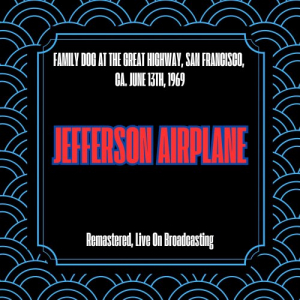
| Artist | Jefferson Airplane Related artists |
| Album name | Family Dog at the Great Highway, San Francisco, Ca. June 13th, 1969 (Remastered, Live On Broadcasting) |
| Country | |
| Date | 2025 |
| Genre | Rock,Psychedelic Rock,Acid Rock,Folk Rock |
| Play time | 1:13:02 |
| Format / Bitrate | Stereo 1420 Kbps
/ 44.1 kHz MP3 320 Kbps |
| Media | CD |
| Size | 403 MB |
| Price | Download $3.95 |
Order this album and it will be available for purchase and further download within 12 hours
Pre-order album Tracks list
	Tracklist:

1. Jam (Live) (14:04)
2. Other Side of This Life (Live) (06:14)
3. Wooden Ships (Live) (05:31)
4. JPP McStep B Blues Wooden Ships (Live) (02:37)
5. Crown of Creation (Live) (02:54)
6. Greasy Heart (Live) (03:11)
7. Good Shepherd (Live) (06:28)
8. Fat Angel (Live) (08:38)
9. Volunteers (Live) (03:43)
10. The Ballad of You and Me and Pooneil (Live) (07:52)
11. Eskimo Blue Day (Live) (05:35)
12. House at Pooneil Corners (Live) (06:11)


 moreThe initial idea for the group that became Jefferson Airplane came from
23-year-old Marty Balin, a San Francisco-raised singer who had recorded
unsuccessfully for Challenge Records in 1962 and been a member of a folk group
called the Town Criers in 1963-1964. With the Beatles-led British Invasion of
1964, Balin saw the merging of folk with rock in early 1965 and decided to form
a group to play the hybrid style as well as open a club for the group to play
in. He interested three investors in converting a pizza restaurant on Fillmore
Street into a 100-seat venue called the Matrix, and he began picking potential
bandmembers from among the musicians at a folk club called the Drinking Gourd.
His first recruit was rhythm guitarist/singer Paul Kantner, who in turn
recommended lead guitarist/singer Jorma Kaukonen. Balin, who possessed a keening
tenor, wanted a complementary powerful female voice for the group and found it
in Signe Toly. The six-piece band was completed by bass player Bob Harvey and
drummer Jerry Peloquin. Their unusual name was suggested by Kaukonen, who had
once jokingly been dubbed "Blind Thomas Jefferson Airplane" by a friend in
reference to the blues singer Blind Lemon Jefferson.

Jefferson Airplane made their debut at the Matrix on August 13, 1965 and began
performing at the club regularly. They attracted favorable press attention,
which -- at a time when folk-rock performers like Sonny & Cher, We Five, Bob
Dylan, the Byrds, the Beau Brummels, and the Turtles were all over the charts --
led to record company interest. By September, Jefferson Airplane was being wooed
by several labels. At the same time, the band was already undergoing changes.
Peloquin was fired and replaced by Skip Spence. Spence considered himself a
guitarist, not a drummer, but he had some drumming experience. Also in
September, Signe Toly married Jerry Anderson, who handled lights at the Matrix,
becoming known as Signe Anderson. In October, Harvey was fired and replaced by
Jack Casady, a friend of Kaukonen's. On November 15, 1965, this lineup -- Balin,
Kantner, Anderson, Kaukonen, Spence, and Casady -- signed to RCA Victor Records.
They had their first recording session in Los Angeles on December 16, and RCA
released their debut single, Balin's composition "It's No Secret," in February
1966; it didn't chart. Meanwhile, Jefferson Airplane began to appear at more
prestigious venues in San Francisco and tour outside the Bay Area. In May 1966,
Anderson gave birth to a daughter, and caring for the child while performing
with the band became a challenge. Meanwhile, Spence became increasingly
unreliable as his appetite for drugs increased and was replaced in June by
session drummer Spencer Dryden. Spence went on to form the band Moby Grape.

Following a second non-charting single, Balin and Kantner's "Come Up the Years,"
in July, Jefferson Airplane released their debut LP, Jefferson Airplane Takes
Off, on August 15, 1966, just over a year after the band's debut. The album had
modest sales, peaking at only number 128 during its 11 weeks on the Billboard
chart. (A third single, Balin and Kantner's "Bringing Me Down," was released
from the album, but didn't chart.) At this point, Anderson's commitment to her
family led her departure from the group. Jefferson Airplane was able to find a
strong replacement for her in Grace Slick, the lead singer for the San Francisco
rock band the Great Society, which happened to be in the process of breaking up
at the same time. Slick joined Jefferson Airplane in mid-October 1966, and by
the end of the month, was with them in the recording studio. She brought with
her two songs from the Great Society repertoire: the rock tune "Somebody to
Love," written by her brother-in-law Darby Slick, the Great Society's guitarist,
and her own composition, the ballad "White Rabbit," set to a bolero tempo, which
used imagery from Alice in Wonderland to discuss the impact of psychedelic
drugs. Both songs were recorded for Jefferson Airplane's second album,
Surrealistic Pillow.

RCA did not release either of them as the advance single from the album, opting
instead for the departed Spence's "My Best Friend" in January 1967; it became
the group's fourth single to miss the charts. Surrealistic Pillow followed in
February. It debuted in the charts the last week of March, and its progress sped
up with the release of "Somebody to Love," the first Jefferson Airplane single
to feature Grace Slick as lead vocalist. By early May, both the album and single
were in the Top 40 of their respective charts; a month later, both were in the
Top Ten. With that, RCA released "White Rabbit" as a single, and it too reached
the Top Ten. Surrealistic Pillow became Jefferson Airplane's first gold album in
July.

Meanwhile, the band, which, naturally, had attracted national media attention
(much of it focusing on Slick's photogenic looks), began recording a new album
and continued to tour. On June 17, 1967, they performed at the Monterey
International Pop Festival, which was celebrated for introducing many of the new
San Francisco rock bands (as well as the Jimi Hendrix Experience) and launching
the "Summer of Love" in 1967. Jefferson Airplane's performance was filmed and
recorded. Two songs from their show, "High Flying Bird" and "Today," were
featured in the documentary Monterey Pop, released in 1968. The concert
recording was heavily bootlegged and over the years has turned up on numerous
gray-market releases as well.

The nature of Jefferson Airplane's commercial breakthrough, and the nature of
the band itself, restricted their commercial appeal thereafter. AM Top 40 radio,
in particular, became wary of a group that had scored a hit with a song widely
derided for its drug references, and Jefferson Airplane never again enjoyed the
kind of widespread radio support they would have needed to score more Top Ten
hits. At the same time, the group did not think of itself as a hitmaking
machine, and its recordings were becoming more adventurous. Kantner's "The
Ballad of You and Me and Pooneil," the band's new single released in August,
featured him as lead singer with Slick and Balin harmonizing. It reached number
42 on the strength of the band's prominence. At the same time, the rise of FM
radio, attracted to longer cuts and the kind of experimental work the group was
starting to do, gave them a new way of exposing their music. Nevertheless, their
third album, After Bathing at Baxter's, its songs arranged into lengthy suites,
was not as successful as Surrealistic Pillow when it appeared on November 27,
1967, reaching the Top 20 but failing to go gold. Also notable was the
diminished participation of Marty Balin, who co-wrote only one song, and now was
being marginalized in the group he had founded.

After Kantner's "Watch Her Ride," released as a single from After Bathing at
Baxter's, stalled at number 61, RCA released a new Jefferson Airplane single
written and sung by Slick in the spring of 1968. But radio was even more
resistant, and "Greasy Heart" stopped at number 98. It was included on the
band's fourth album, Crown of Creation, released in August. The title track got
to number 64 as a single, and the LP, which featured more concise, less
experimental tracks than After Bathing at Baxter's, marked a resurgence in the
group's commercial success, reaching the Top Ten and eventually going gold.
Jefferson Airplane's live appeal was chronicled on the concert album Bless Its
Pointed Little Head, released in February 1969. In August, the group appeared at
the Woodstock festival, and it was featured on the million-selling triple-LP
soundtrack album to the resulting film in 1970, though it did not appear
onscreen in the version initially released. The band's fifth studio album,
Volunteers, appeared in October 1969 as its title song became a minor singles
chart entry. Volunteers stopped short of the Top Ten, but it went gold in three
months. On December 6, 1969, the band played at the Rolling Stones' disastrous
Altamont free concert in California, its performance (complete with Balin's
beating at the hands of Hell's Angels) captured in the 1970 documentary film
Gimme Shelter.

Jefferson Airplane released one more single, the non-charting marijuana anthem
"Mexico," in 1970 in its familiar configuration, but the turn of the 1970s
brought great changes in the group. Already, Kaukonen and Casady, with assorted
sidemen, had begun to play separately as Hot Tuna while maintaining their
membership in Jefferson Airplane; they had recorded shows the previous September
for a self-titled debut album issued in May 1970. Spencer Dryden was fired early
in the year and replaced by drummer Joey Covington. At shows performed in
October 1970, violinist Papa John Creach, who had been performing with Hot Tuna,
first played with Jefferson Airplane. Creach was a journeyman musician decades
older than any of the other bandmembers, and his recruitment was evidence of the
ways in which the band's approach was changing. An even more radical change was
the departure of Marty Balin, who left the band at the end of the fall tour in
November.

Jefferson Airplane did not have a new album ready for release in 1970, and RCA
filled the gap with a compilation, sarcastically dubbed The Worst of Jefferson
Airplane and released in November. The album went gold quickly and was later
certified platinum. Issued on its heels was Paul Kantner's debut solo album,
Blows Against the Empire, featuring most of the members of Jefferson Airplane as
well as various other musical friends. Due to that long list of sidemen and the
album's science fiction theme about a group of hippies hijacking a spaceship,
Kantner co-billed the disc to "Jefferson Starship." As yet, there was no such
entity, but Kantner would use the name for a real band later.

Having completed their recording commitment to RCA, Jefferson Airplane shopped
for a new label, but was wooed back when RCA offered them their own imprint,
Grunt Records. Grunt bowed with the release of the sixth Jefferson Airplane
studio album, Bark, in August 1971. The album stopped just short of the Top Ten
and quickly went gold. Covington, Casady, and Kaukonen's "Pretty as You Feel,"
later issued as a single, gave the band its final placing in the Hot 100 at
number 60 early in 1972. Grunt issued albums by bandmembers including Creach and
Hot Tuna, as well as discs by friends, but Jefferson Airplane remained its most
successful act.

In the early '70s, Jefferson Airplane became increasingly preoccupied by their
side projects. Hot Tuna, having issued a second live album, First Pull Up, Then
Pull Down, in the spring of 1971, put out their first studio effort, Burgers, in
February 1972. Kantner and Slick, who had become a couple and had a child,
issued a duo album, Sunfighter, in December 1971. In April 1972, Covington left
the band and was replaced by veteran drummer John Barbata, formerly a member of
the Turtles and a backup musician for Crosby, Stills, Nash & Young. The group
then recorded its seventh studio album, Long John Silver, which was issued in
the summer of 1972. It reached the Top 20 and went gold within six months. For
the accompanying tour, they added singer/multi-instrumentalist David Freiberg,
formerly a member of the San Francisco rock band Quicksilver Messenger Service,
to provide the male lead vocals formerly sung by Balin.

The tour concluded at the Winterland ballroom in San Francisco on September 22,
1972, in effect marking the end of Jefferson Airplane. Kaukonen and Casady went
back to performing as Hot Tuna. Kantner, Slick, and Freiberg recorded a trio
album, Baron von Tollbooth & the Chrome Nun, issued in the spring of 1973 and
featuring the rest of Jefferson Airplane as side musicians. Slick's debut solo
album, Manhole, issued in early 1974, also featured many of the same performers.
Kantner and Slick then organized a new band along the same lines as Jefferson
Airplane, but without Kaukonen and Casady, and called it Jefferson Starship.
Drummer John Barbata would go on to work with Jefferson Starship; he died on May
8, 2024 at the age of 79. Meanwhile, a second Jefferson Airplane live album
drawn from the 1972 tour, Thirty Seconds Over Winterland, was issued in the
spring of 1973. Early Flight, a collection of stray tracks, appeared in the
spring of 1974. Grunt issued the compilation Flight Log (1966-1976) at the start
of 1977, filling the two LPs with tracks by Jefferson Airplane, Jefferson
Starship, and various other spinoff acts. 2400 Fulton Street: An Anthology,
named after the address of a house owned by the band in the '60s, was a two-disc
set released in 1987. All of these albums sold well enough to reach the charts.

The various members of Jefferson Airplane went through various solo efforts and
group affiliations in the '70s and '80s, plus considerable litigation with an
old manager and each other. This was all cleared up by the late '80s, however,
and in 1989, Kantner, Slick, Kaukonen, and Casady (who, with manager Bill
Thompson, still owned the rights to the name Jefferson Airplane) brought in
Balin (who had sold out his share in the group in 1971) and reunited as
Jefferson Airplane for a tour and album. The tour, which ran from August 18 to
October 7, was well-received; but the album Jefferson Airplane was only a modest
success. After that, the band again became inactive. Slick retired. Kaukonen and
Casady resumed performing as Hot Tuna. Kantner eventually resurrected the
Jefferson Starship name, sometimes including Balin and even occasionally Slick,
and playing Jefferson Airplane songs. RCA continued to release archival
recordings, its most interesting issues being the 1992 box set Jefferson
Airplane Loves You and the 1998 concert recording Live at the Fillmore East. On
January 28, 2016, Kantner died of multiple organ failure in San Francisco at the
age of 74 -- the same day, and at the same age that original Airplane singer
Signe Anderson died at her home in Beaverton, Oregon. On September 27, 2018,
Marty Balin died in Tampa, Florida, at the age of 76. © William Ruhlmann


Jefferson Airplane - Family Dog at the Great Highway, San Francisco, Ca. June
13th, 1969.rar -  403.2 MB
Related artists
Jefferson Airplane
Album
- 2025 Come On Now Together (Live San Francisco 88)
- 2025 Family Dog at the Great Highway, San Francisco, Ca. June 13th, 1969 (Remastered, Live On Broadcasting)
- 2025 Fillmore Auditorium, San Francisco, Ca. October 14th, 1966 (Remastered, Live On Broadcasting)
- 2023 O'Keefe Centre, Toronto 1967
- 2020 Stony Brook 1970
- 2020 Complete Broadcasts 1965-1970 [Remastered]
- 2020 Jefferson Airplane - KSAN FM Broadcast Family Dog At The Great Highway 13th June 1969 Part One.
- 2020 Jefferson Airplane - KSAN FM Broadcast Family Dog At The Great Highway 13th June 1969 Part Two.
- 2019 This is Jefferson Airplane
- 2015 Bark (expanded Edition)
- 2015 Somebody To Love
- 2014 High Flyin' Bird
- 2014 Two Artists for One Price - Jefferson Airplane & Slowburner
- 2013 Rock for You - Jefferson Airplane
- 2012 In Concert
- 2012 The Best of Jefferson Airplane
- 2012 The Essential Jefferson Airplane / Jefferson Starship / Starship
- 2012 At the Family Dog Ballroom
- 2012 Rock Legends - Jefferson Airplane
- 2012 Last Flight
- 2011 Return To The Matrix
- 2011 Flight Log 1966-1976 [Remastered]
- 2010 Live At The Fillmore Auditorium 10.16.66. Early & Late Shows - Grace's Debut
- 2010 Live At The Fillmore Auditorium 10/16/66
- 2010 Studio Session
- 2010 Don't Slip Away
- 2010 Cleared For Take-Off
- 2010 Other Side Of Life
- 2010 Live At The Fillmore Auditorium 11/25/66 & 11/27/66
- 2009 The Woodstock Experience
- 2009 Jefferson Airplane: The Woodstock Experience
- 2007 Last Flight (2CD)
- 2007 Last Flight CD1
- 2006 The Worst Of Jefferson Airplane (2006 Remaster)
- 2005 The Essential Jefferson Airplane
- 2004 Collections
- 2003 Surrealistic Pillow [2003, Remastered]
- 2001 The Roar Of Jefferson Airplane
- 2001 Greatest Hits
- 1996 Feed Your Head
- 1996 Journey (the Best Of)
- 1995 White Rabbit
- 1992 Loves You
- 1992 Jefferson Airplane Loves You
- 1991 Live At The Monterey Festival
- 1989 Jefferson Airplane
- 1987 2400 Fulton Street
- 1974 Early Flight
- 1973 Thirty Seconds Over Winterland [3]
- 1972 Long John Silver [2]
- 1972 Bless Its Pointed Little Head
- 1971 Bark [3]
- 1970 The Worst Of Jefferson Airplane
- 1969 Live At Golden Gate Park
- 1969 Bless Its Pointed Little Head [2]
- 1969 Volunteers [6]
- 1969 Bless Its Pointed Lettle Head [2004, Remastered]
- 1968 Crown Of Creation [6]
- 1968 Crown Of Creation - Remastered - 2003
- 1968 After Bathing At Baxter S
- 1967 After Bathing At Baxter's [3]
- 1967 Return To The Matrix (live) 1967-2-1 (2CD)
- 1967 Surrealistic Pillow [6]
- 1967 Surrealistic Pillow [2013, CFU01028, RE, RM, US]
- 1967 Surrealistic Pillow
- 1967 Surrealistic Pillow [2003, Bonus Tracks]
- 1967 Surrealistic Pillow [2003, Remastered Reissue With Bonus Tracks, EU]
- 1967 Surrealistic Pillow [2016, SACD, UDSACD 2175, RE, RM, US]
- 1967 Surrealistic Pillow (bvcm-37625 Japan Cardboard Sleeve 2008)
- 1967 After Bathing At Baxters
- 1966 Takes Off [4]
- 1966 Jefferson Airplane Takes Off
Compilation
- 2019 All the Best
- 2014 The Box Set Series [4CD]
- 2012 Jefferson Airplane: The Collection (Live)
- 2011 Original Album Classics [88697854312, RE, EU]
- 2008 Original Album Classics [88697313862, RE, EU]
- 1997 The Gold Collection. Classic Performances
- 1996 The Best Of Jefferson Airplane [1967-1974]
- 1996 Journey The Best Of
- 1995 Greatest Hits
- 1972, 1973 Long John Silver / Thirty Seconds Over Winterland [2020 Remastered]
EP
- 2021 White Rabbit [2]
Live album
- 2025 Concertgebouw, Amsterdam, Netherlands, September 15th, 1968 [Remastered]
- 2025 Fillmore West, San Francisco, Ca. October 4th, 1970 [Remastered]
- 2025 Silver Sunlight
- 2024 An Electric Sign (Live Amsterdam '68)
- 2023 Live at the Monterey International Pop Festival
- 2023 We Can Be Together
- 2022 Central Park New York '76
- 2019 Live at Winterland
- 2019 Jefferson Airplane - Live Radio Broadcast (Live)
- 2019 Whatever the Old Man Wants (Live)
- 2019 Woodstock Sunday August 17, 1969 (Live)
- 2016 Jefferson Airplane Live In San Francisco 1966
- 2014 Live at the Fillmore, November 25th 1966
- 2013 Living Through Chemistry
- 2011 Live At The Fillmore Auditorium 11/25/66 & 11/27/66 - We Have Ignition
- 2011 Live At The Fillmore Auditorium 10/15/66 (Late Show - Signe's Farewell)
- 2011 Somebody to Love: Live Hits
- 2010 The Very Best Of Jefferson Airplane Live
- 2010 Setlist: The Very Best Of Jefferson Airplane LIVE
- 2007 Sweeping Up the Spotlight - Jefferson Airplane Live at the Fillmore East 1969
- 1998 Live At The Fillmore East [2]
- 1996 Feed Your Head: Live '67-'69 [PLATCD 201, UK]
- 1995 White Rabbit (Live)
- 1970 Last Stand At Winterland (Live)