
Tim Bowness - Lost in the Ghost Light / Stupid Things That Mean the World '2017
24bit
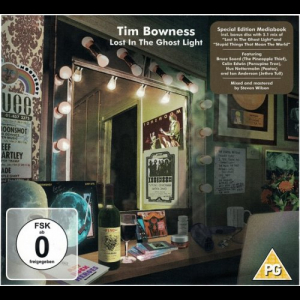
| Artist | Tim Bowness Related artists |
| Album name | Lost in the Ghost Light / Stupid Things That Mean the World |
| Country | |
| Date | 2017 |
| Genre | Prog Rock |
| Play time | : 01:25:46 |
| Format / Bitrate | 24 BIT Stereo 2429 Kbps / 96 kHz |
| Media | WEB |
| Size | : 1,8 GB (+3%rec.) |
| Price | Download $8.95 |
Order this album and it will be available for purchase and further download within 12 hours
Pre-order album Tracks list
	It’s a somewhat hidden truth that a sizeable percentage of any musician’s
fan base believes that the music their favorite artists make is a direct
reflection of their tastes. While an artist’s music ought, indeed, be a
reflection of what moves them, it’s another truth that, more often than not,
their listening habits run much farther afield.
One way to develop a more thorough appreciation for an artist’s tastes,
touchstones and influences is to look at their entire discography, assuming
they’ve been around long enough to build one sizeable enough to tell a more
complete tale. Still, even looking at discography that is now entering its
fourth decade doesn’t necessarily tell the whole story, as is the case with
Tim Bowness.
Lost in the Ghost Light is Bowness’ third solo release since 2014’s
Abandoned Dancehall Dreams (Inside Out)— his first “real” solo album
despite releasing My Hotel Year in 2004, which Bowness describes, in the 2017
All About Jazz interview that accompanies this review, as “. . . pieces from
several separate projects I was working on in the early 2000s. It’s a solo
album in name mainly, though I did define its shape and sound.”
Lost in the Ghost Light shares certain unmistakable stylistic commonalities with
the British singer, songwriter and multi-instrumentalist's previous two records,
and his work in No-Man, Bowness’ longstanding collaboration with fellow solo
artist Steven Wilson, which—on hiatus since 2008—may well be firing back up
in the near-to-mid-range future. At the same time, it represents something
completely different in Bowness’ discography, whether it’s solo, as
co-leader of groups including No-Man, Henry Fool (along with Ghost Light
compositional collaborator/keyboardist/guitarist Stephen Bennett) and his duo
project with bassist/keyboardist Peter Chilvers, or as a guest with groups
including Centrozoon, The Opium Cartel and Darkroom and singer Judy Dyble.
Progressive rock—in particular the “softer side” of the genre that grew to
massive popularity in the ’70s before being hit hard by a number of factors
towards the end of the decade and in the years since, until its unexpected
resurgence of popularity over the past 15-20 years—has always been one of the
undercurrents running beneath Bowness’ music. That said, it’s important to
appreciate the true breadth and depth of his musical addiction, best expressed
in his AAJ interview. Suffice to say that Bowness views music as a much larger
continuum than any single genre, and is a fan of everything from the Moody
Blues, Procol Harum, Simon and Garfunkel, The Beatles and Frank Sinatra to Randy
Newman, Joni Mitchell and Leonard Cohen. . . not to mention a passion for Kate
Bush and David Bowie, XTC, John Foxx/Ultravox, David Sylvian, Japan, and Joy
Division, as well as American art-rockers including Talking Heads, Patti Smith,
Lou Reed and Velvet Underground.
But amidst these diverse artists and stylists, progressive rock remains a major
motivator because, as Bowness articulates in the interview: “. . . contrary to
its reputation as being distant, bloated and exhibitionist, for me the best
progressive rock contains soaring imagination alongside rare emotional
intensity. As much as my tastes have evolved over the years and my own music has
developed along different paths, the idealism of progressive music remains a
touchstone. Prog may have been occasionally ridiculous, pompous, and
overreaching, but it was rarely boring.”
If Abandoned Dancehall Dreams and its 2015 Inside Out follow-up, Stupid Things
That Mean the World were superb records informed by progressive music, Lost in
the Ghost Light is—not unlike his No-Man partner Steven Wilson’s
unexpectedly massively successful 2013 album The Raven That Refused to Sing and
Other Stories (Kscope)—unapologetically a flat-out progressive rock record,
albeit one that could only come from Bowness’ cooperative pen with Stephen
Bennett. Relying more on soft melodies and cinematic atmospheres than The
Raven’s often overtly virtuosic, high-energy and high-octane music: Strawbs,
early Phil Collins-era Genesis and Camel, then, rather than Yes, Mahavishnu
Orchestra, and King Crimson.
That’s not to say there isn’t any heat on Lost in the Ghost Light; the
frenzied “Kill the Pain That’s Killing You” is one of Bowness’ most
aggressive songs ever, from his processed vocals and fiery guitar work from
Bruce Soord to the fierce rhythmic underpinning from Sanguine Hum drummer Andrew
Booker and Burnt Belief/Porcupine Tree’s Colin Edwin—the only other constant
on the album along with Bennett. . . and a more fluid, intuitive and tasteful
yet absolutely unshakable bassist you’d be hard-pressed to find.
The Pineapple Thief guitarist was chosen for this project because, as Bowness
articulates, “. . . he has a songwriter’s approach to guitar solos in that
he’s direct and melodic. [Regular guitarist, Darkroom’s] Michael Bearpark is
great but he’s from the abstract school of noise that includes David Torn and
Neil Young. The Ghost Light songs needed something different.”
But Soord isn’t the only name guest to appear on Lost in the Ghost Light;
amongst the many usual suspects who have populated solo albums and some No-Man
releases in the past, Bowness recruited undervalued American progressive rock
group Happy the Man’s Kit Watkins for some evocative flute work on the opening
“Worlds of Yesterday” and brief, Van der Graaf Generator-informed title
track, while Jethro Tull founder, songwriter, guitarist and woodwind
multi-instrumentalist Ian Anderson contributes a particularly moving flute solo
on the closing, Novatron-driven ballad “Distant Summers,” complete with
unison vocalizing and occasional signature trills, as well as perfectly placed
fills throughout.
Much of Ghost Light was co-written with Bennett, who brings a broader harmonic
palette to the project. There are intentional nods to Genesis in the 12-string
guitars and, most notably, in its reference to keyboardist Tony Banks’
distinctive voicings on “Moonshot Manchild,” where Bowness was thinking
about “Genesis b-sides from the late 1970s and early 1980s[, which] had a
chordal sophistication and exploratory shape that seemed absent from
contemporary pop.” Bennett’s lush, orchestral support on the track—the
album’s second, and sharing certain thematic motifs with the opening,
similarly image-inducing “Worlds of Yesterday”—are particularly wonderful
for being played on the Novatron 400, a late-’70s renaming of the original
tape-driven orchestra/choral sampler, the Mellotron, which in many ways defined
the sound of progressive rock from its early days through recordings from the
Moody Blues, King Crimson, Yes. . . and, of course, Genesis.
But it’s not just soft symphonic leanings amidst acoustic and electric guitars
that are at the heart of Lost in the Ghost Light’s compositional treasures;
amidst the album’s eight tracks and 43-minute run-time there are hints of the
Beatles, Pink Floyd and Peter Hammill. . . even slight tinged of Caravan and
Camel. . . all subsumed within Bowness’ increasingly distinctive writing
style, which capitalizes on his work with No-Man and Henry Fool but expands his
purview even further than ever before. Lost in the Ghost Light may be an
unapologetically progressive rock record with its roots in music of the
late-’60s/early-’70s, but it’s also an unequivocally contemporary album.
While Ghost Light possesses a number of progressive rock (and some rock opera)
signatures—in addition to the Novatron/Mellotron, there are vintage
synthesizers, episodic compositions, recurring themes, irregular meters. . . and
the flute, another popular instrument back in the day that has experienced a bit
of a resurgence with contemporary groups including Britain’s Big Big Train,
Sweden’s Änglagárd, Norway’s White Willow and Italy’s Höstsonaten—it
still fits seamlessly within Bowness’ broader discography, his melancholic
ballads and sometimes wisp-like vocals a soft, dreamy constant.
Possessed, in turns, of pop-like elegance and more complex compositional and
textural constructs, Lost in the Ghost Light may be a concept album like ’70s
releases including Yes’ Tales from Topographic Oceans (Atlantic; reissued by
Panegyric in 2016) and Genesis’ The Lamb Lies Down on Broadway (Charisma,
remixed/reissued by Rhino in 2008), but unlike those predecessors its story is
not oblique (or completely incomprehensible). Instead, it’s a very direct and
personal story that may be about a fictitious band (Moonshot) and, in
particular, its lead singer, Jeff Harrison—who is caught sitting in front of a
mirror in his dressing room after a gig, looking back on a “life sentence”
in music, for all its challenges and all its rewards—but it’s as much a
reflection on Bowness’ own life in music, from questioning the relevance of a
lifelong career as it enters its twilight years on “World of Yesterday” to
“You’ll Be the Silence,” where Bowness’ sums up Harrison’s lot his
most succinct best: “Once the world was yours / And the world was for people
like you. / Now the world is theirs / And the world is for people like them.”
Still in his fifties, Bowness has yet to enter its career’s final chapter, and
his recent string of solo albums has proven amongst the most successful and
critically acclaimed of his career. Clearly an artist who has plenty left to
say—and one for whom the world still remains his—with Lost in the Ghost
Light, Bowness has delivered another persuasive, evocative and provocative album
that, with its more direct progressive tendencies and a group of perfectly
chosen musicians—including a non-performing Steven Wilson, who mixed Lost in
the Ghost Light (as he did Abandoned Dancehall Dreams) and mastered the
album—has managed to raise his already top-level game.
As a concept album—and with Abandoned Dancehall Dreams and Stupid Things That
Mean the World giving him plenty of additional material—Lost in the Ghost
Light has the potential to become a terrific, full-length live show, so here’s
hoping that Bowness gets the chance to hit the road with some of the album’s
key players. . . perhaps, even, get out of Europe and aim for some North
American dates: at this stage in his career as a solo artist, it’s time. In
the meantime, the thoroughly compelling Lost in the Ghost Light represents
forward motion for Bowness even as it looks back, wistfully, at a time when,
musically speaking, anything seemed possible. . . and everything was allowed.
(John Kelman, All About Jazz, 19 Feb. 2017)
https://www.allaboutjazz.com/lost-in-the-ghostlight-by-john-kelman.php


Tracks:

Lost in the Ghost Light (2017)
01. Worlds of Yesterday (Stephen Bennett / Tim Bowness) 05:41
02. Moonshot Manchild (Stephen Bennett / Tim Bowness) 08:58
03. Kill the Pain That’s Killing You (Tim Bowness / Andy Butler / Alistair
Murphy) 03:44
04. Nowhere Good to Go (Stephen Bennett / Tim Bowness) 04:46
05. You’ll Be the Silence (Stephen Bennett / Tim Bowness) 09:01
06. Lost in the Ghost Light (Tim Bowness) 01:40
07. You Wanted to Be Seen (Stephen Bennett / Tim Bowness) 05:32
08. Distant Summers (Stephen Bennett / Tim Bowness) 04:06

Stupid Things That Mean the World (2015)
09. The Great Electric Teenage Dream (Stephen Bennett / Tim Bowness) 03:58
10. Sing to Me (Tim Bowness / Steven Wilson) 05:46
11. Where You’ve Always Been (Tim Bowness / Phil Manzanera) 04:07
12. Stupid Things That Mean the World (Tim Bowness) 03:05
13. Know That You Were Loved (Tim Bowness) 06:44
14. Press Reset (Tim Bowness) 03:54
15. All These Escapes (Tim Bowness / Brian Hulse) 03:06
16. Everything You’re Not (Tim Bowness) 03:40
17. Everything But You (Tim Bowness) 01:12
18. Soft William (Tim Bowness) 01:40
19. At the End of the Holiday (Tim Bowness / Andrew Keeling) 04:58

Personnel:

Personnel on Lost In The Ghost Light:
Tim Bowness: vocals, backing vocals (2-4, 7-8), synthesizers (6), rhythm
programming (6)
Bruce Soord: acoustic and electric guitars (1), electric guitar solos (1, 3, 5),
backing vocals (1), electric guitar (7, 8)
Colin Edwin: bass (1, 3-4), fretless bass (2, 5), bass harmonics solo (5),
double bass (8)
Ricard ‘Huxflux’ Nettermalm: drums (1, 2, 5); Kit Watkins: flutes (1, 6),
waterphone (6)
Stephen Bennett: organ (1-2, 4-5, 7), acoustic and electric pianos (1-2, 5),
Novatron 400 (1-2, 4-5, 7-8), synthesizers (1-2, 5, 7-8), acoustic and electric
6-and 12-string guitars (1-2, 4), E-Bow solo (1), Hohner Pianet (2, 7), piano
(4, 7-8), Spitfire Brass (4-5), electric guitar (5), Univox Drum Machine (5)
David Rhodes: electric guitar (3, 7)
Andrew Booker: drums (3-4, 7-8)
Andrew Keeling: string arrangements (3-5), flutes (3-5), acoustic and classical
guitars (4)
Charlotte Dowding: violin ensemble (3-5)
The ‘unknown’ Pete Smith: Rickenbacker bass (7), bass pedals (7)
Steve Bingham: violin (7-8)
Ian Anderson: flute (8)

Personnel on Stupid Things That Mean The World
Tim Bowness: vocals, keyboards, guitar, programming
with:
Stephen James Bennett: keyboards, programming
Michael Bearpark: guitars
Andrew Keeling: string arrangements, acoustic guitars (“At the End of the
Holiday”)
Colin Edwin: fretless bass, double bass
Andrew Booker: drums
Pat Mastelotto: drums
Charlotte Dowling - violin ensemble
Anna Phoebe: violin
Bruce Soord: guitar, bass, programming
Peter Hammill: slide guitar, vocals
Phil Manzanera: guitar, vocals, keyboards
David Rhodes: guitar, backing vocals
Rhys Marsh: pedal steel guitar
Related artists
Tim Bowness
Album
- 2024 Powder Dry
- 2022 Butterfly Mind [Limited Edition]
- 2022 Memories of Machines
- 2020 Late Night Laments (Bonus Tracks Edition)
- 2019 Flowers At The Scene [2]
- 2017 Lost In The Ghost Light
- 2017 Lost in the Ghost Light / Stupid Things That Mean the World
- 2015 Stupid Things That Mean The World (2CD)
- 2015 Stupid Things That Mean the World
- 2014 Abandoned Dancehall Dreams [2]
- 2008 My Hotel Year
- 2004 Sleepwalker (CDS)