
Kris Kristofferson - The Record Plant 1973 (Live) '2025
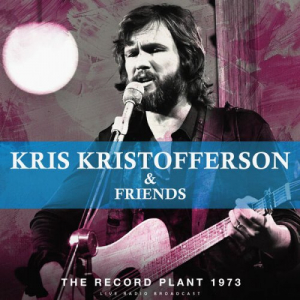
| Artist | Kris Kristofferson Related artists |
| Album name | The Record Plant 1973 (Live) |
| Country | |
| Date | 2025 |
| Genre | Country,Folk |
| Play time | 1:02:13 |
| Format / Bitrate | Stereo 1420 Kbps
/ 44.1 kHz MP3 320 Kbps |
| Media | CD |
| Size | 289 MB |
| Price | Download $2.95 |
Order this album and it will be available for purchase and further download within 12 hours
Pre-order album Tracks list
	Tracklist:

1. The Late John Garfield Blues (Live) (02:54)
2. Same Old Song (Live) (03:43)
3. Loving Her Was Easier (Live) (04:01)
4. Out Of Mind, Out Of Sight (Live) (02:54)
5. Late Again (Live) (03:59)
6. Looks Like Baby's Gone (Live) (02:46)
7. Billy Dee (Live) (05:14)
8. Help Me Make It Through The Night (Live) (03:04)
9. I Never Had It So Good (Live) (01:33)
10. Eight Day Clock (Live) (03:25)
11. Blue Highway (Live) (05:52)
12. I'll Change Your Flat Tyre Merle (Live) (03:32)
13. Settle It In The Bedroom (Live) (07:17)
14. Tom Donohue Interview (Live) (01:46)
15. Come On John (Live) (04:55)
16. Me and Bobby McGee (Live) (05:13)


 moreThe eldest of three children of an Air Force major general who retired
from the military to head up air operations for the Saudi Arabian company
Aramco, Kristofferson spent most of his childhood in Brownsville, Texas, though
his family moved around, finally settling in San Mateo, California by his junior
high school years. He graduated from San Mateo High School in 1954 and entered
Pomona College in Claremont, California. There he studied creative writing and
he won first prize and three other placements in a collegiate short-story
contest sponsored by Atlantic Monthly magazine. He graduated Phi Beta Kappa in
1958, having secured a prestigious Rhodes scholarship to continue his studies at
Oxford University in England. While at Oxford, he wrote and performed his own
songs, which brought him to the attention of manager Larry Parnes (who handled
Tommy Steele and other British pop stars). Signing with Parnes, he made
recordings for Top Rank Records produced by Tony Hatch (apparently never
released) and performed under the name Kris Carson, but he was not successful.

After earning a master's degree in English literature from Oxford in 1960,
Kristofferson intended to continue his studies there. But during a Christmas
break back home in California, he resumed his relationship with an old
girlfriend, Fran Beir, and they married. Instead of returning to Oxford, he
joined the Army. Like his father, he became a pilot, learning to fly
helicopters. He was assigned to West Germany and went there with his wife and
their daughter. During the early '60s, while rising to the rank of captain, he
eventually returned to writing and performing, organizing a soldiers' band to
play at service clubs. Hearing his songs, a friend suggested sending them to a
relative of his, the Nashville songwriter Marijohn Wilkin. Kristofferson did so
and he received encouragement from Wilkin, who had become a music publisher by
founding Bighorn Music. In 1965, Kristofferson was reassigned to the West Point
military academy, where he was to become an English instructor. He spent a
two-week leave in June 1965 in Nashville, where he looked up Wilkin and decided
to try to become a country songwriter instead. He resigned his commission and
moved his family to Nashville, and signed to Bighorn, which gave him a small
weekly stipend that he augmented with a variety of jobs, including janitorial
work, bartending, and flying helicopters to and from offshore oil rigs in the
Gulf of Mexico. He and his wife eventually divorced.

Kristofferson scored his first success as a songwriter with "Viet Nam Blues,"
which was recorded by Dave Dudley and peaked in the country Top 20 in April
1966. As a recording artist, Kristofferson was signed to Epic Records and
released a lone single, "Golden Idol"/"Killing Time," in 1967, but it missed the
charts. (He later re-recorded both songs for his Surreal Thing album.) Roy
Drusky recorded Kristofferson's "Jody and the Kid" and took it into the country
Top 40 in the summer of 1968 and Billy Walker & the Tennessee Walkers' version
of his "From the Bottle to the Bottom" peaked in the Top 20 of the country
charts in April 1969. But by that spring, those three chart placings and his
failed single were all Kristofferson had to show for almost four years of effort
in Nashville. He had moved to Fred Foster's Columbine Music and begun to
collaborate occasionally with Foster; he got a break when Roger Miller decided
to record one of their songs, "Me and Bobby McGee," a ballad about hobo'ing that
recalled earlier Miller hits like "King of the Road," but with more of a hippie
slant. Miller ended up recording not only "Me and Bobby McGee," but also two
other Kristofferson compositions, "Best of All Possible Worlds" and "Darby's
Castle," for his August 1969 album Roger Miller. "Me and Bobby McGee" was
released as a single in advance of the album and it peaked in the country Top
20. Meanwhile, Kristofferson had begun to gain recognition as a performer,
thanks to Johnny Cash, who introduced him at the Newport Folk Festival that
summer and featured him on his network television show.

In September 1969, Kristofferson earned another important cover when Ray Stevens
released a version of his reflection on a hangover, "Sunday Mornin' Comin'
Down," as a single. It entered both the pop and country charts. The following
month, Faron Young released "Your Time's Comin'," co-written by Kristofferson
and Shel Silverstein. It gave the songwriter his biggest hit so far when it
peaked in the country Top Five in December 1969. Jerry Lee Lewis' recording of
Kristofferson and Silverstein's "Once More with Feeling" did even better, just
missing the top of the country charts in March 1970.

In addition to Columbine Music, Fred Foster also ran Monument Records, an
independent label, and he signed Kristofferson to it as a recording artist.
Kristofferson went into the studio and cut his own versions of some of the songs
others had already done -- "Me and Bobby McGee," "Best of All Possible Worlds,"
"Darby's Castle," "Sunday Mornin' Comin' Down" -- as well as some new songs,
notably "Help Me Make It Through the Night" and "For the Good Times," both
romantic ballads with a decidedly erotic tone. His debut album, titled
Kristofferson, was released in April 1970 and he promoted it with his first
major concert tour, debuting at the Troubadour in Los Angeles on June 23,
appearing at the giant Isle of Wight Festival on July 26, and playing the Bitter
End in New York in August. Despite favorable reviews, the album sold poorly and
quickly went out of print.

The demand for his songs, however, only increased. The same month that
Kristofferson was released, Ray Price reached the country charts with "For the
Good Times," though it had been intended as the B-side of the single. It hit
number one in September and crossed over to the pop charts, where it reached the
Top 20; as a result, "For the Good Times" was named Song of the Year for 1970 by
the Academy of Country Music. In August, Waylon Jennings reached the country
charts with Kristofferson and Silverstein's "The Taker," which peaked in the Top
Five in October and crossed over to the pop charts. By then, Johnny Cash had
entered the country charts with his version of "Sunday Morning Coming Down" (as
he called it, restoring the dropped "g"). It hit number one in October and
crossed over to the pop charts, and that same month it won the Country Music
Association's Song of the Year Award for 1970, putting Kristofferson in the
unusual position of winning the same award from country's two rival
organizations for the same year with different songs.

But the string of hits was far from over. In December, Sammi Smith entered the
country charts with "Help Me Make It Through the Night," giving the song a
surprising twist by having the woman ask the man to sleep with her instead of
the other way around. The single crossed over to the pop charts, eventually
reaching the Top Ten and going gold, and it gave Kristofferson his third country
chart-topper in February 1971. Meanwhile, Bobby Bare's recording of
Kristofferson's "Come Sundown" had also reached the country charts in December
and it peaked in the Top Ten in February 1971. Up to this point, Kristofferson
had been getting most of his recognition in country music, but that changed in
January 1971 when Janis Joplin's posthumous album Pearl was released. Joplin had
covered "Me and Bobby McGee" and it was released as a single, shooting up the
pop charts to number one in March. That same month, Ray Price followed "For the
Good Times" with another Kristofferson song, "I Won't Mention It Again," which
crossed over to the pop charts and in May gave the songwriter his fourth country
number one hit within eight months. Meanwhile, Joe Simon got into the pop charts
with his version of "Help Me Make It Through the Night" in April, Bobby Bare
charted at country in May with Kristofferson's "Please Don't Tell Me How the
Story Ends," which peaked in the Top Ten in July, and Peggy Little reached the
country charts with his "I've Got to Have You."

Despite all this sudden success as a songwriter, Kristofferson had not yet
achieved any great notice as a performer. Monument had been purchased by CBS
Records and turned into a subsidiary of the Columbia label, giving its artists
the benefit of major-label distribution and promotion. Kristofferson released
his second album, The Silver Tongued Devil and I, in July 1971. Again, it
combined the songwriter's own versions of songs that he had scored for others --
"Jody and the Kid," "The Taker" -- with important new work, notably the ballad
"Loving Her Was Easier (Than Anything I'll Ever Do Again)," which Roger Miller
quickly covered for a Top 40 country hit. The album finally broke Kristofferson
as a recording artist, rising into the Top Five of the country charts and the
Top 20 of the pop charts and going gold, with the songwriter's own version of
"Loving Her Was Easier (Than Anything I'll Ever Do Again)" becoming a Top 40 pop
and Top Five easy listening hit. In August, Monument re-released Kristofferson's
first album, renaming it Me and Bobby McGee. This time, the LP reached the
country Top Ten and the pop Top 100 and went gold. Meanwhile, Ray Price released
his third consecutive single of a Kristofferson song, "I'd Rather Be Sorry," and
it just missed topping the country charts in October while crossing over to the
pop charts. Patti Page also made the country charts with her version of the
song. Jerry Lee Lewis put "Me and Bobby McGee" into the charts for a third time
in November; it was given some country airplay as the B-side of his number one
country single "Would You Take Another Chance on Me," while pop radio flipped
the disc over and made it a Top 40 pop hit. The same month, O.C. Smith got into
the pop charts with his version of "Help Me Make It Through the Night."

Kristofferson himself, meanwhile, had traveled to Peru at the behest of director
Dennis Hopper, and he made his film debut in a bit part in The Last Movie,
released in September, to which he also contributed songs. The same month, part
of his performance from the Isle of Wight Festival was in the charts on the
triple-record set First Great Rock Festivals of the Seventies: Isle of
Wight/Atlanta Pop F…. (In 1997, the film and CD Message to Love: The Isle
of Wight also featured his appearance.) He had a more substantial film role in
Cisco Pike, released early in 1972, also getting to sing several more of his
songs. In February, he released his third album, Border Lord. It was his first
collection to consist of all-new material and proved to be a slight commercial
disappointment, reaching only the Top 100 of the pop charts and the Top Ten of
the country charts, its single "Josie" becoming a pop and country chart entry
but not a big hit. In March, however, three of his songs, "For the Good Times,"
"Help Me Make It Through the Night," and "Me and Bobby McGee," were among the
five nominees for the 1971 Grammy Award for Best Country Song, while "Help Me
Make It Through the Night" and "Me and Bobby McGee" were also up for the Song of
the Year Grammy. Competing against himself, he managed to win his first Grammy
for Best Country Song for "Help Me Make It Through the Night." The same month,
Gladys Knight & the Pips brought the song back into the pop Top 40 and also made
the R&B Top 20 with their rendition. In April, Kristofferson was in the charts
with another live recording, appearing on the various-artists collection Big Sur
Festival/One Hand Clapping. In June, Sammi Smith made the country charts with
her version of "I've Got to Have You," which peaked in the Top 20 in September
and also crossed over to the pop charts.

Having taken only seven months between his second and third albums,
Kristofferson waited only nine more months before delivering his fourth album,
Jesus Was a Capricorn, in November 1972. Initially, the LP did not do as well as
Border Lord, itself a step down from The Silver Tongued Devil and I, as the
title song barely made the pop singles charts and a second single, "Jesse
Younger," missed the charts entirely. But in March 1973, Monument released a
third single, the slow, pious "Why Me," which topped the country charts in July
and went gold, also crossing over to the pop Top 20. With that, sales of Jesus
Was a Capricorn rebounded and the album hit number one in the country charts a
year after it was released. (Meanwhile, Brenda Lee had covered "Nobody Wins"
from the album for a Top Five country hit and a pop chart entry.)

Kristofferson, meanwhile, had returned to acting, getting more substantial film
roles and working with important directors. In 1973, he appeared in Paul
Mazursky's Blume in Love, also contributing a couple of songs, and in Sam
Peckinpah's Pat Garrett and Billy the Kid, he co-starred as Billy the Kid in the
latter. His notices tended to be better than those for the films themselves and
indicated that he had a future in movies.

On August 19, 1973, Kristofferson married singer Rita Coolidge (who soon bore
him a second daughter) and the following month the couple released a duo album,
Full Moon. It was a big hit, topping the country charts, reaching the Top 40 of
the pop charts, and going gold. Its first single, the Kristofferson's
composition "A Song I'd Like to Sing," was a Top 20 easy listening hit, a Top 40
pop hit, and a country chart entry. "Loving Arms," a second single, made the
easy listening Top 40 and also reached the pop and country charts. The couple's
version of "From the Bottle to the Bottom" won the 1973 Grammy Award for Best
Country Vocal Performance by a Duo or Group. (Due to the peculiarities of the
Grammy eligibility rules, "Loving Arms" was nominated in the same category the
following year.) Kristofferson also earned 1973 Grammy nominations for Best
Country Song and Best Country Vocal Performance, Male, for "Why Me."

In April 1974, "One Day at a Time," written by Kristofferson and Marijohn
Wilkin, reached the country charts in a recording by Marilyn Sellars that went
on to peak in the Top 20. Later in the year, it reached the pop Top 40.
Kristofferson's fifth album, Spooky Lady's Sideshow, was released in May.
Compared to earlier releases, it was a commercial disappointment, reaching the
Top Ten of the country charts but only the Top 100 of the pop charts, with no
charting single. From this point on, Kristofferson's albums would be only modest
sellers at best, but he remained a potent country songwriter. In July, Ronnie
Milsap entered the country charts with a revival of "Please Don't Tell Me How
the Story Ends"; by September it had topped the country charts and crossed over
to pop. Kristofferson continued to pursue his film career, taking a small part
in Sam Peckinpah's Bring Me the Head of Alfredo Garcia, released in the summer,
and a co-starring role in Martin Scorsese's Alice Doesn't Live Here Anymore,
which appeared in December. Also that month, Kristofferson and Coolidge released
their second duo album, Breakaway. Though less successful than their first one,
it reached the Top 100 of the pop charts and the Top Five of the country charts.
The single "Rain" made the country and easy listening charts. "Lover Please"
also got into the easy listening charts and it went on to win the duo a second
Grammy for Best Country Vocal Performance by a Duo or Group.

Kristofferson took a break from moviemaking to concentrate on his musical career
and his sixth album, Who's to Bless and Who's to Blame, was released in November
1975. But the extra effort did not translate into increased sales. The LP
reached the country Top 40, but it missed the Top 100 of the pop charts. Johnny
Duncan's recording of the Kristofferson song "Stranger" from the album became a
country hit, however, reaching the Top Five. Kristofferson returned to the
movies and in the spring of 1976 was seen in Vigilante Force and The Sailor Who
Fell from Grace with the Sea, also contributing a song to the latter. His
seventh album, Surreal Thing, followed his sixth by only eight months. It was
another commercial disappointment, reaching the country Top Ten while barely
registering in the pop charts. But in December 1976, he enjoyed both a hit movie
and a hit record with the release of A Star Is Born, in which he co-starred with
Barbra Streisand. Critics howled, but the film was a box office smash, second
only to Rocky among motion pictures released in 1976 as the top-grossing hit,
while the soundtrack album, which featured several contributions from
Kristofferson (among them the pop chart entry "Watch Closely Now"), topped the
pop charts and sold several million copies. Of course, Streisand had more to do
with all that than Kristofferson did, but he was awarded a Golden Globe for Best
Actor.

Monument Records seized upon the occasion of his increased profile to release a
compilation, Songs of Kristofferson, in April 1977. It did considerably better
than his other '70s releases of new material, making the country Top Ten and the
pop Top 100 and earning a gold record. Making only one film in 1977, Semi-Tough,
released in the fall, he worked on his eighth album for more than a
year-and-a-half, not releasing Easter Island until March 1978. It marked a
slight commercial uptick, charting higher in the pop and country charts than his
previous effort, but did not restore his commercial fortunes as a recording
artist. Returning to the movies, Kristofferson starred in Convoy, a film
extrapolation of the 1976 song hit by C.W. McCall, which opened in the summer.
In January 1979, he and Coolidge released their third duo album, Natural Act,
which was another modest seller.

Kristofferson's personal life and professional career were both at low points in
the late '70s and early '80s. His ninth album, Shake Hands with the Devil, was
released in September 1979 and did not sell well enough to reach the charts,
though the single "Prove It to You One More Time Again" was a country singles
chart entry. His next film, Freedom Road, was not given a theatrical release in
the U.S., instead being broadcast on television in October. In December he and
Coolidge divorced. At the same time, however, his song catalog continued to
prosper. Lena Martell's cover of "One Day at a Time" hit number one in the U.K.
in October, and in the U.S., Cristy Lane revived the song, taking it to number
one in the country charts in June 1980. Willie Nelson Sings Kris Kristofferson
was released in October 1979 and made the country Top Five, as did Nelson's
single release of "Help Me Make It Through the Night." Kristofferson toured with
Nelson during the winter of 1979 and 1980. During this period, he was also
working on what should have been his greatest cinematic triumph yet, though it
turned into a debacle. This was Heaven's Gate, director Michael Cimino's
follow-up to his Academy Award-winning film The Deer Hunter. The lengthy,
expensive film debuted to negative reviews in November 1980 and was such a
financial catastrophe that it bankrupted the movie studio that made it.
Kristofferson had already been contracted to make another film, Rollover,
released in 1981, but his association with Heaven's Gate may have scared off
casting directors, since he didn't appear in another film until 1984. Meanwhile,
he released his tenth album, To the Bone, in January 1981, and it became his
second LP to miss the pop charts, although it made the country charts briefly,
as did the single "Nobody Loves Anybody Anymore." But the old songs continued to
sell; in July, Tompall & the Glaser Brothers just missed topping the country
charts with their revival of "Lovin' Her Was Easier (Than Anything I'll Ever Do
Again)."

Except for a non-charting single, "Here Comes That Rainbow Again"/"The Bandits
of Beverly Hills," Kristofferson was not heard from for the rest of 1981 and
most of 1982, resurfacing in November 1982 with the release of the double-album
The Winning Hand, a group effort credited to "Kris [Kristofferson], Willie
[Nelson], Dolly [Parton] & Brenda [Lee]." The album reached the country Top
Five, though it failed to cross the 100 mark on the pop charts. In February,
1983, Kristofferson married for the third time, wedding attorney Lisa Meyers,
with whom he eventually had five more children. He returned to filmmaking in
January 1984 with the television broadcast of The Lost Honor of Kathryn Beck,
and made it back into movie theaters later that year with Flashpoint, a mystery,
and Songwriter. In the latter, he co-starred with Willie Nelson in a story about
the Nashville music industry. He wrote a number of songs for the film, resulting
in his first Academy Award nomination for original song score. Columbia released
Music from Songwriter, a duo album by Nelson and Kristofferson on which the two
sang separately and shared a couple of duets. The album reached the pop charts
and the Top 20 of the country charts, and one of the duets, Kristofferson's "How
Do You Feel About Foolin' Around," made the country singles charts.

Kristofferson and Nelson expanded their partnership into a supergroup quartet
with the addition of Johnny Cash and Waylon Jennings to create the album
Highwayman, released in April 1985. The title track, a song about reincarnation
written by Jimmy Webb, with each group member taking a verse, topped the country
charts in August and the LP was also a number one country hit, going gold. A
second single, Guy Clark's "Desperados Waiting for a Train," made the country
Top 20. The recordings were billed to the four participants by name, but the
group came to be known informally as the Highwaymen, though a settlement had to
be made with the '60s folk group of the same name for it to be used legally.

In December 1985, Kristofferson starred in Alan Rudolph's film Trouble in Mind,
also contributing the theme song, "El Gavilan" ("The Hawk," after the name of
his character), sung by Marianne Faithfull. He put the song on Repossessed, his
first solo album in six years, which was released on Mercury Records in February
1987. Reflecting his left-wing views, particularly on American military
involvement in Central America, Repossessed spent six months in the country
charts, and "They Killed Him," a tribute to Christ, Gandhi, and Martin Luther
King, Jr., placed in the country singles charts. Simultaneous with the release
of the LP, Kristofferson appeared in Amerika, a controversial week-long
television mini-series that fantasized about the U.S. under Communist
domination. It was one of many TV movie projects the actor had made in the
mid-'80s, a time when his feature film work remained sparse.

Highwayman 2 appeared in February 1990, preceded by a single "Silver Stallion,"
that made the country Top 40. The album reached the country Top Five and earned
a Grammy nomination for Best Country Vocal Collaboration. Kristofferson followed
Repossessed with a second Mercury album, Third World Warrior, in March 1990.
Another work of agit-prop, it failed to reach the charts. In 1991,
Columbia/Legacy released the compilation Singer/Songwriter, a double-CD set
containing both Kristofferson's versions of his best-known songs and the
best-known covers of them by people like Janis Joplin and Ray Price. The
archival label followed in 1992 with the previously unreleased concert set Live
at the Philharmonic, recorded in 1972. Kristofferson worked steadily in TV
movies and independent features during the late '80s and early '90s; he wrote
the score for the 1993 film Cheatin' Hearts, in which he also appeared. The
Highwaymen's third album, The Road Goes on Forever, appeared in April 1995 and
made the country charts. As a solo artist, Kristofferson had teamed with
producer Don Was to record a new album, A Moment of Forever, for Was'
Karambolage imprint in 1993, but an initial distribution deal fell through and
the album was not released until August 1995, when it appeared on the Texas
independent label Justice Records. Four years later, Kristofferson released The
Austin Sessions, an album of remakes of his most popular songs. (In the
mid-'90s, One Way Records reissued many of Kristofferson's Monument albums on
CD.)

Kristofferson's appearance in director John Sayles' 1996 film Lone Star marked a
turning point in his film career. Taking a supporting role as a corrupt sheriff,
the 60-year-old actor displayed a flair for character parts and villains that
vastly increased his offers from Hollywood in the late '90s and led to his
appearances in such major-studio action features as Fire Down Below, Blade, and
Payback. He also earned admiring critical notices as a James Jones-like novelist
in A Soldier's Daughter Never Cries and in another Sayles film, Limbo.

Although his film work kept him busy, Kristofferson returned to music with a
live set, Broken Freedom Song, released on John Prine's Oh Boy Records in 2003.
That was followed in 2006 by the Don Was-produced This Old Road on New West
Records. A second New West album, Closer to the Bone, arrived in 2009. Both
albums found Kristofferson striking an earthy, introspective tone and earned him
Top 20 positions on Billboard's Independent Albums chart. More honest and rootsy
vibes marked 2013's Feeling Mortal, which hit number nine on the folk chart. In
2016 he released Cedar Creek Sessions, which he recorded in Austin and which
earned a Grammy nomination for Best Americana Album. A year later, he
contributed a song to Brandi Carlile's charity album Covers Stories with
proceeds benefitting War Child UK. Following appearances at Joni Mitchell's 2018
75th Birthday concert and as part of the 2020 Outlaw Country Cruise,
Kristofferson quietly retired in January 2021. Kris Kristofferson died at his
home in Maui, Hawaii, on September 28, 2024, surrounded by his family. He was 88
years old. © Matt Collar


Kris Kristofferson - The Record Plant 1973 (Live).rar -  289.4 MB
Related artists
Kris Kristofferson
Album
- 2025 Hittin Close To Home (Live Reseda 82)
- 2025 The Record Plant 1973 (Live)
- 2024 Out Of Line (Live)
- 2021 Johnny Cash: Forever Words [Expanded Edition]
- 2021 Natural Act
- 2021 Whisper Of The Raindrops (Live New York '79)
- 2020 Repossessed
- 2020 Third World Warrior
- 2018 Full Moon [Expanded Edition]
- 2017 The Austin Sessions (Expanded Edition)
- 2016 Demos
- 2014 An Evening with Kris Kristofferson (The Pilgrim Ch 77 - Union Chapel, London)
- 2012 Feeling Mortal
- 2010 Please Don't Tell Me How The Story Ends: The Publishing Demos 1968-72
- 2009 Closer To The Bone {u.s. Pressing}
- 2009 Closer to the Bone
- 2006 This Old Road
- 2004 The Essential Kris Kristofferson (2CD)
- 1999 The Austin Sessions [2]
- 1995 A Moment Of Forever
- 1982 The Winning Hand
- 1981 To The Bone [2016, RE, RM, US]
- 1979 Shake Hands With The Devil [2]
- 1978 Easter Island [2016, RE, RM, US]
- 1976 Surreal Thing [2016, RE, RM, US]
- 1975 Who's To Bless And Who's To Blame [2016, RE, RM, US]
- 1974 Breakaway [2016, RE, RM, US]
- 1974 Spooky Lady's Sideshow [3]
- 1973 Full Moon
- 1972 Jesus Was A Capricorn [2]
- 1972 Border Lord [2]
- 1972 Live at RCA Studios 1972 [2016 Remastered]
- 1971 The Silver Tongued Devil And I [2]
- 1970 Kristofferson [3]
- 1970 Me And Bobby McGee [1990, 465866 2, RE, RM, UK]
Anthology
Compilation
- 2022 The Silver Tongued Devil and I, Border Lord, Jesus Was A Capricorn, Spooky Lady's Sideshow [SACD, 2CDLK 4635, UK]
- 2016 Demos (Previously Unreleased) [US]
- 2016 Extras [US]
- 2010 Please Dont Tell Me How the Story Ends: The Publishing Demos (1968-72)
- 2009 Original Album Classics [88697574442, EU]
- 1974 Original Album Classics (3CD)
Live album
- 2020 Boboquivari 71 (KCET Broadcast) [Remastered]
- 2019 Once Upon A Time In California (with Rita Coolidge & Doug Sahm) (Live 1973)
- 2003 Broken Freedom Song: Live from San Francisco
- 1981 Live From Austin, TX [2018, RE, RM, US]
- 1972 Live At The Philharmonic [2016, RE, RM, US]
- 1972 The WPLJ-FM Broadcast [2016, RE, RM, US]
- 1970 Live At The Big Sur Folk Festival [2016, RE, RM, US]