
Paul Mccartney - Live at Glastonbury Festival 2004 '2025
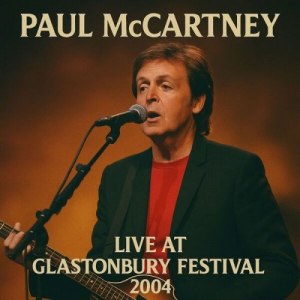
| Artist | Paul Mccartney Related artists |
| Album name | Live at Glastonbury Festival 2004 |
| Country | |
| Date | 2025 |
| Genre | Rock,Pop Rock |
| Play time | 1:17:09 |
| Format / Bitrate | Stereo 1420 Kbps
/ 44.1 kHz MP3 320 Kbps |
| Media | CD |
| Size | 462 MB |
| Price | Download $3.95 |
Order this album and it will be available for purchase and further download within 12 hours
Pre-order album Tracks list
	Tracklist:

1. Jet (04:47)
2. Flaming Pie (02:54)
3. Let Me Roll It (06:23)
4. Blackbird (02:48)
5. Drive My Car (02:27)
6. Penny Lane (03:08)
7. Get Back (03:57)
8. Band on the Run (05:17)
9. Back in Ussr (03:41)
10. Live and Let Die (03:30)
11. Lady Madonna (02:45)
12. Hey Jude (10:16)
13. Yesterday (02:44)
14. Follow Me (02:55)
15. Let It Be (04:26)
16. I Saw Her Standing There (03:17)
17. Helter Skelter (05:52)
18. Sgt. Peppers Lonely Hearts Club Band (Reprise)-The End (05:54)


 moreLike John Lennon and George Harrison, McCartney began exploring creative
avenues outside the Beatles during the late '60s, but where his bandmates
released their own experimental records, McCartney confined himself to writing
and producing for other artists, with the exception of his 1966 soundtrack to
The Family Way. Following his marriage to Linda Eastman on March 12, 1969,
McCartney began working at his home studio on his first solo album. He released
McCartney in April 1970, two weeks before the Beatles' Let It Be was scheduled
to hit the stores. Prior to the album's release, he'd announced that the Beatles
were breaking up, against the wishes of the other members. As a result, the
tensions between him and the other three members, particularly Harrison and
Lennon, increased and he earned the ill will of many critics. Nevertheless,
McCartney became a hit, spending three weeks at the top of the American charts.
Early in 1971, he returned with "Another Day," which became his first hit single
as a solo artist. It was followed several months later by Ram, another homemade
collection, this time featuring the contributions of his wife, Linda.

By the end of 1971, the McCartneys had formed Wings, which was intended to be a
full-fledged recording and touring band. Former Moody Blues guitarist Denny
Laine and drummer Denny Seiwell became the group's other members, and Wings
released their first album, Wild Life, in December 1971. Wild Life was greeted
with poor reviews and was a relative flop. McCartney and Wings, which now
featured former Grease Band guitarist Henry McCullough, spent 1972 as a working
band, releasing three singles -- the protest "Give Ireland Back to the Irish,"
the reggae-fied "Mary Had a Little Lamb," and the rocking "Hi Hi Hi." Red Rose
Speedway followed in the spring of 1973, and while it received weak reviews, it
became his second American number one album. Later in 1973, Wings embarked on
their first British tour, at the conclusion of which McCullough and Seiwell left
the band. Prior to their departure, McCartney's theme to the James Bond movie
Live and Let Die became a Top Ten hit in the U.S. and U.K. That summer, the
remaining Wings proceeded to record a new album in Nigeria. Released late in
1973, Band on the Run was simultaneously McCartney's best-reviewed album and his
most successful, spending four weeks at the top of the U.S. charts and
eventually going triple-platinum.

Following the success of Band on the Run, McCartney formed a new version of
Wings with guitarist Jimmy McCulloch and drummer Geoff Britton. The new lineup
was showcased on the 1974 British single "Junior's Farm" and the 1975 hit album
Venus and Mars. At the Speed of Sound followed in 1976; it was the first Wings
record to feature songwriting contributions by the other bandmembers.
Nevertheless, the album became a monster success on the basis of two McCartney
songs, "Silly Love Songs" and "Let 'Em In." Wings supported the album with their
first international tour, which broke many attendance records and was captured
on the live triple-album Wings Over America (1976). After the tour was
completed, Wings rested a bit during 1977, as McCartney released an instrumental
version of Ram under the name Thrillington, and produced Denny Laine's solo
album Holly Days. Later that year, Wings released "Mull of Kintyre," which
became the biggest-selling British single of all time, selling over two million
copies. Wings followed "Mull of Kintyre" with London Town in 1978, which became
another platinum record. After its release, McCulloch left the band to join the
re-formed Small Faces, and Wings released Back to the Egg in 1979. Though the
record went platinum, it failed to produce any big hits. Early in 1980,
McCartney was arrested for marijuana possession at the beginning of a Japanese
tour; he was imprisoned for ten days and then released, without any charges
being pressed.

Wings effectively broke up in the wake of McCartney's Japanese bust, although
its official dissolution was not announced until April 27, 1981, when Denny
Laine left the band. Back in England, McCartney recorded McCartney II, which was
a one-man band effort like his solo debut. Ironically, the hit single associated
with the album was a live take of the song "Coming Up" that had been recorded in
Glasgow with Wings in December 1979 and was intended to be the B-side of the 45,
with the solo studio recording as the A-side. DJs preferred the live version,
however, and it went on to hit number one. Later in 1980, McCartney entered the
studio with Beatles producer George Martin to make Tug of War.

Released in the spring of 1982, Tug of War received the best reviews of any
McCartney record since Band on the Run and spawned the number one single with
"Ebony and Ivory," a duet with Stevie Wonder that became McCartney's biggest
American hit. In 1982, McCartney sang on "The Girl Is Mine," the first single
from Michael Jackson's blockbuster album Thriller. Jackson duetted with
McCartney on "Say Say Say," the first single from McCartney's 1983 album Pipes
of Peace (though the song was actually recorded two years earlier) and the last
number one single of his career. The relationship between Jackson and McCartney
soured considerably when Jackson bought the publishing rights to the Beatles'
songs out from underneath McCartney in 1985.

McCartney directed his first feature film in 1984 with Give My Regards to Broad
Street. While the soundtrack, which featured new songs and re-recorded Beatles
tunes, was a hit, generating the hit single "No More Lonely Nights," the film
was a flop, earning terrible reviews. The following year, he had his last
American Top Ten with the theme to the Chevy Chase/Dan Aykroyd comedy Spies Like
Us. Press to Play (1986) received some strong reviews but was another flop. In
1988, he recorded a collection of rock & roll oldies called Choba B CCCP for
release in the U.S.S.R.; it was given official release in the U.S. and U.K. in
1991. For 1989's Flowers in the Dirt, McCartney co-wrote several songs with
Elvis Costello; the pair also wrote songs for Costello's Spike, including the
hit "Veronica." Flowers in the Dirt received the strongest reviews of any
McCartney release since Tug of War, and was supported by an extensive
international tour, which was captured on the live double-album Tripping the
Live Fantastic (1990). For the tour, McCartney hired guitarist Robbie McIntosh
and bassist Hamish Stuart, who would form the core of his band until 1993.

Early in 1991, McCartney released another live album in the form of Unplugged,
which was taken from his appearance on MTV's acoustic concert program of the
same name; it was the first Unplugged album to be released. Later that year, he
unveiled Liverpool Oratorio, his first classical work. Another pop album, Off
the Ground, followed in 1993, but failed to generate any big hits, despite
McCartney's successful supporting tour. Following the completion of the New
World tour, he released another live album, Paul Is Live, in December 1993. In
1994, he released an ambient techno album under the pseudonym the Fireman.
McCartney premiered his second classical piece, The Leaf, early in 1995 and then
began hosting a Westwood One radio series called Oobu Joobu. But his primary
activity in 1995, as well as 1996, was the Beatles' Anthology, which encompassed
a lengthy video documentary of the band and the multi-volume release of Beatles
outtakes and rarities. After Anthology was completed, he released Flaming Pie in
summer 1997. A low-key, largely acoustic affair that had some of the same charm
of his debut, Flaming Pie was given the strongest reviews McCartney had received
in years and was a modest commercial success, debuting at number two on the U.S.
and U.K. charts; it was his highest American chart placing since he left the
Beatles. Flaming Pie certainly benefited from the success of Anthology, as did
McCartney himself -- only a few months before the release of the album in 1997,
he received a Knighthood.

On April 17, 1998, Linda McCartney died after a three-year struggle with breast
cancer. A grieving Paul kept a low profile in the months to follow, but finally
returned in fall 1999 with Run Devil Run, a collection that primarily included
cover songs. The electronica-based Liverpool Sound Collage followed a year
later, and the pop album Driving Rain -- a successor, of sorts, to Flaming Pie
-- came a year after that. The live album Back in the U.S. appeared in America
in 2002 with the slightly different international edition, Back in the World,
following soon after.

McCartney's next studio project included sessions with super-producer Nigel
Godrich, the results of which appeared on the mellow Chaos and Creation in the
Back Yard, released in late 2005. The album reached the Top Ten in more than a
dozen countries, including the U.S. and U.K. McCartney performed every
instrument (apart from six songs featuring his touring band) on 2007's David
Kahne-produced Memory Almost Full, a bold but whimsical collection of new songs,
some of which had been recorded before the Chaos and Creation in the Back Yard
sessions. It too reached the Top Ten across the world. A live CD/DVD set, Good
Evening New York City, appeared in 2009. The following year, McCartney kicked
off an extensive reissue campaign with a box set of Band on the Run, and he
supported the reissue with an American tour in the summer of 2011.

Later in 2011, McCartney released his first ballet, Ocean's Kingdom, and less
than a year later followed with another first -- his first collection of
pre-WWII standards. The latter work, titled Kisses on the Bottom, topped the
U.S. jazz charts and reached the Top Five in seven different countries. His busy
year continued during the summer, when he ended the opening ceremony of London's
2012 Olympics with a set that included a customary extended version of "Hey
Jude." A surprising cap to 2012 came that December when he appeared on-stage
with the surviving ex-members of Nirvana as part of a benefit concert for
victims of Hurricane Sandy.

The year 2013 brought recording sessions with four of McCartney's favorite
producers: Paul Epworth, Ethan Johns, Giles Martin, and Mark Ronson. His initial
intention had been to hold trial sessions with each producer, aiming to select
one of them to oversee the whole of his next album. However, each of them had a
hand in producing New, his first album of original material in six years, which
appeared that October. New debuted in the Top Ten in more than a dozen countries
and McCartney supported the album over the next two years with a series of
international tours. In 2015, he continued his ongoing Paul McCartney Archive
Collection with deluxe reissues of Tug of War and Pipes of Peace. The next
summer, he released Pure McCartney, a personally curated overview of his solo
career available in two separate incarnations: a double-disc set and a four-disc
box. Flowers in the Dirt arrived in early 2017 as part of the singer's Archive
Collection. In September 2018, he delivered the Greg Kurstin-produced Egypt
Station, his 17th solo album; it was preceded by the singles "I Don't Know,"
"Come on to Me," and "Fuh You." Egypt Station became McCartney's first number
one album in the U.S. since Tug of War; in the U.K. it debuted at three.

A couple of non-LP tracks from the Egypt Station sessions appeared in 2019, then
McCartney released an Archive edition of Flaming Pie in July 2020. The bigger
news for 2020 was the recording and release of McCartney III, an album McCartney
wrote and recorded on his own during the global lockdown of 2020. McCartney III
appeared on December 18, 2020, giving McCartney his first number one album in
the U.K. since Flowers in the Dirt; it debuted at two in the U.S. and spawned a
2021 album of "reinterpretations, remixes, and covers" called McCartney III
Imagined.

McCartney spent the early years balancing archival projects with his Got Back
tour, which headed through the United States in 2022, made a stop at the
Glastonbury Festival the same year -- he became the oldest headliner in the
festival's history -- and then toured the rest of the world throughout 2024. He
published The Lyrics: 1956 to the Present in November 2021 and in 2023, he
released 1964: Eyes of the Storm, a photo book containing pictures he shot
during the pivotal moment of Beatlemania. McCartney celebrated the 50th
Anniversary of Band on the Run by releasing an "Underdubbed Mix" of the album in
early 2024, following it swiftly in June with the first official audio release
of One Hand Clapping, a live-in-the-studio concert film from 1974 that sat on
the shelf until the 2010 Paul McCartney Archive edition of Band on the Run. A
2025 documentary, Man on the Run, followed McCartney's career in the immediate
aftermath of the Beatles' split through Wings' heyday. © Stephen Thomas
Erlewine


Paul McCartney - Live at Glastonbury Festival 2004.rar -  462.3 MB
Paul Mccartney
Album
- 2025 Best Of Europe 73 (Live)
- 2025 Live at Glastonbury Festival 2004
- 2023 Live at Tokyo Dome 1990-03-07
- 2021 Mccartney III Imagined [2]
- 2020 McCartney III [2]
- 2020 Family
- 2020 Home
- 2020 Love
- 2019 Egypt Station [3]
- 2019 Paul Is Live
- 2019 Amoeba Gig [2]
- 2019 Twin Freaks
- 2019 RAM [2]
- 2019 CHOBA B CCCP
- 2018 / 2019 Egypt Station: Explorers Edition
- 2018 Egypt Station [3]
- 2018 Egypt Station - Explorer's Edition [2019, UICC-90010, JAPAN]
- 2018 Spotify Singles: Under The Staircase
- 2016 Pure Mccartney (2CD)
- 2015 The Space Within Us
- 2014 New (2CD) [Сollector's Edition]
- 2013-2014 NEW [Deluxe Edition + Collectors Editio]
- 2013 New [6]
- 2012 Kisses On The Bottom [4]
- 2011 Mccartney (2011 Remaster, Deluxe Edition) (CD1)
- 2011 Mccartney (2011 Remaster, Deluxe Edition) (CD2)
- 2011 Mccartney II (2011 Remaster, Deluxe Edition) (CD1)
- 2011 Mccartney II (2011 Remaster, Deluxe Edition) (CD2)
- 2011 Mccartney II (2011 Remaster, Deluxe Edition) (CD3)
- 2011 McCartney II [2]
- 2009 Amoeba's Secret
- 2009 Good Evening New York City
- 2007 Memory Almost Full [3]
- 2006 Ecce Cor Meum
- 2005 Chaos And Creation In The Backyard
- 2005 Listen...To What The Man Said
- 2005 Pizza And Fairy Tales
- 2004 Something For The Weekend... Paul McCartneys Glastonbury Groove
- 2004 Flowers In The Dirt Sessions [3CD]
- 2003 Back In The World
- 2003 Live At The Cavern Club!
- 2003 Live At Coliseum, Rome (10.05.03) (2CD)
- 2002 Back In The U.S. Live 2002 (CD1)
- 2002 Back In The U.S. Live 2002 (CD2)
- 2002 Back In The U.s. - Live 2002 (2CD)
- 2002 Freedom
- 2001 Driving Rain
- 2001 Wingspan (2CD)
- 2001 Wingspan: Hits And History
- 2001 From A Lover To A Friend
- 2000 Liverpool Sound Collage [7243 528817 2 7, UK]
- 2000 Return To Pepperland: The Unreleased 1987 Album
- 1999 Working Classical.
- 1999 Run Devil Run
- 1999 Unplugged
- 1998 The Alternate Band On The Run {Pear 001}
- 1997 Flaming Pie [5]
- 1997 Paul McCartney's Standing Stone [7243 5 56484 2 6, UK]
- 1997 Standing Stone
- 1997 Beautiful Night
- 1997 Oobu Joobu - Ecology
- 1996 The Animated Film Soundtracks
- 1995 Oobu Joobu Part 11 & 12
- 1995 Oobu Joobu Part 13 & 14
- 1995 Oobu Joobu Part 15-17
- 1995 Oobu Joobu Part 4
- 1995 Oobu Joobu Part 5
- 1995 Oobu Joobu Part 6
- 1995 Oobu Joobu Part 7 & 8
- 1995 Oobu Joobu Part 9 & 10
- 1995 Oobu Joobu Parts 1-2
- 1993 Biker Like An Icon
- 1993 Off The Ground [2]
- 1993 Off The Ground, Empty Space Delights
- 1991 Liverpool Oratorio (CD1)
- 1991 Liverpool Oratorio (CD2)
- 1990 All My Trials
- 1990 The Long And Winding Road
- 1990 One Hand Clapping [2024 Remastered]
- 1989 Flowers In The Dirt [9]
- 1989 Flowers In The Dirt (Japan 1st Press CP28-5850)
- 1989 Flowers In The Dirt [1993, 0777 7 89138 2 5, RM, UK]
- 1989 Flowers In The Dirt [2017, Special Edition]
- 1989 Flowers In The Dirt (2CD)
- 1989 Flowers In The Dirt
- 1989 Flowers In The Dirt [2017, B0025988-00, RE, RM, DLX, EU]
- 1989 Flowers In The Dirt [2017, B0025988-00, DLX, RE, UK]
- 1989 Flowers In The Dirt (3CD)
- 1989 Flowers In The Dirt [2017 Super Deluxe Edition, 5CD]
- 1989 My Brave Face
- 1988 [2025] Snova V SSSR
- 1988 Снова В СССР [4]
- 1987 Return To Pepperland - The Unreleased 1987 Album [2]
- 1987 Once Upon A Long Ago
- 1986 Press To Play [4]
- 1986 Press
- 1985 Spies Like Us
- 1984 Give My Regards To Broad Street [2]
- 1983 Pipes Of Peace [5]
- 1982 Tug Of War [7]
- 1982 Tug of War [Deluxe Edition]
- 1982 Take It Away
- 1980 McCartney II [8]
- 1980 McCartney II [1987, CDM 7 52024 2, CD-FA 3191, EU]
- 1980 McCartney II [2011, DLX, RM, US]
- 1980 McCartney II [2014, HRM-36192-25, DLX, RE, RM, US]
- 1980 McCartney II (Remaster)
- 1980 McCartney II [2011, RE, RM, Deluxe Edition, 3CD, HRM-32800-00, US]
- 1980 McCartney II [1987, CD-FA 3191, RE, DE]
- 1980 McCartney II [1993, 0777 7 89137 2 6, RE, RM, NL]
- 1980 McCartney II [2011, HRM-32800-00, RE, RM, DLX, UK]
- 1980 Cold Cuts
- 1977 Thrillington
- 1976 Wings Over America (Remastered) (CD1)
- 1976 Wings Over America (Remastered) (CD2)
- 1976 Wings Over America (Remastered) (CD3)
- 1976 Wings Over America [2024 Remastered]
- 1976 Wings at the Speed of Sound
- 1973 Band On The Run (25Th Anniversary Edition) (CD1)
- 1973 Band On The Run (25Th Anniversary Edition) (CD2)
- 1973 Red Rose Speedway
- 1973 Band On The Run [2010 Remastered]
- 1971 Wild Life
- 1971 Ram [2]
- 1970 McCartney [10]
- 1970 McCartney (DCC Remastered, 24k Gold Edition)
- 1970 McCartney [2011, RE, RM, US]
- 1970 McCartney [2012, HRM-32799-00, RE, RM, US]
- 1970 McCartney [1992, GZS-1029, RE, RM, JAPAN]
- 1970 McCartney [1988, CDP 7 46611 2, RE, US]
- 1970 McCartney [1995, TOCP-3124, RE, RM, JAPAN]
- 1970 McCartney [Vinyl, Gatefold, UK]
- 1970 McCartney [2011, HRM-32799-00, RE, RM, DLX, UK]
- 1970 McCartney [2011 Remastered]
- 1970 McCartney [2024 Remastered]
- 1970 Mccartney [2]
Bootleg
- 2010 Live in Buenos Aires - First Night (November 10th 2010) [3CD]
- 1991 Unplugged (the Official Bootleg)
Compilation
- 2025 WINGS [Deluxe Edition]
- 2023 Got Back Sydney Day 1: Original In Ear Monitor Recording
- 2023 Got Back Sydney Day 2: Original In Ear Monitor Recording
- 2022 The 7'' Singles
- 2016 Pure McCartney [UCCO-8003, RE, RM, JAPAN]
- 2016 Talk More Talk The McCartney Interview Collection [6CD]
- 2007 Star Mark Greatest Hits 2007 (2CD)
- 2006 Fly By Wire
- 2001 Wingspan - Hits And History [2]
- 1998 The Greatest
- 1997 Flaming Pie [2020 Remastered, Archive Collection]
- 1996 Back To The Egg & Pipes Of Peace
- 1996 Ram & Wings Wild Life
- 1995 Gold Singles Collection
- 1993 Off The Ground: The Complete Works
- 1987 All The Best ! [2]
- 1987 Cold Cuts [2002, 0777 7 89005 2 5, RE, RM, UK]
- 1987 All The Best!
EP
- 2024 One Hand Clapping - The Backyard (One Hand Clapping Sessions)
- 2024 One Hand Clapping – The Backyard (One Hand Clapping Sessions)
- 2020 Beautiful Night
- 2020 Holidays
- 2020 The World Tonight
- 1992 Hope Of Deliverance
- 1990 Birthday [EP]
Live album
- 2024 Paul McCartney & Wings - BBC In Concert 1973
- 2024 One Hand Clapping (Live Sessions)
- 2019 Paul Is Live
- 2019 Amoeba Gig
- 2010 Live In Los Angeles [UPPMCMOS01, UK]
- 2003 Tripping The Live Fantastic II [MCCD-020/21, JAPAN]
- 2003 Back In The U.S. Live 2002 (2CD)
- 1993 Paul Is Live [7423 8 27704 2 8, NL]
- 1993 Back In The U.S.A. (Vol. 1) [BAN-029-A, AU]
- 1993 Deliverance Live (2CD)
- 1990 Tripping The Live Fantastic - Highlights [CDP 595379, US]
- 1990 Tripping The Live Fantastic [5]
Mixtape
Single
- 2026 Days We Left Behind [0199957489386, EU]
- 2019 Home Tonight / In A Hurry
- 2018 Come On To Me
- 2018 Fuh You
- 2018 I Don't Know
- 2007 Ever Present Past
- 2005 Fine Line [2]
- 2005 Jenny Wren (UK Maxi-single)
- 2004 Tropic Island Hum & We All Stand Together
- 1997 Young Boy
- 1997 The World Tonight
- 1993 C'mon People
- 1992 Hope Of Deliverance [C2 0777 7 15950 2 8, US]
- 1990 All My Trials
- 1989 Figure Of Eight (2CD) [CDS]
- 1989 This One
- 1984 No More Lonely Nights
Soundtrack